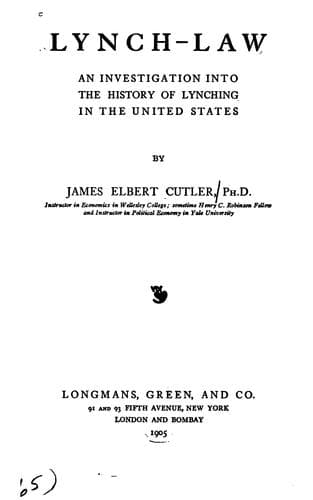
Lynch-law; an investigation into the history of lynching in the United StatesCutler, James Elbert
Philosophy
Lynch-law; an investigation into the history of lynching in the United States
Cutler, James Elbert
Lynching -- United States
At the January term of the supreme court of Ohio in the year 1900 a
decision was rendered on the constitutionality of the “Act for the
Suppression of Mob Violence” which was passed April 10, 1896.[303] Two
cases were before the court. Benjamin F. Church, as the administrator of
Charles W. Mitchell, deceased, filed a petition against the board of
commissioners of Champaign County to recover five thousand dollars for
the lynching of said Mitchell, at Urbana, in said county.[304] Defendant
demurred to the petition and the demurrer was sustained by the court of
common pleas and the petition dismissed. The circuit court reversed the
judgment of the court of common pleas and the case then came before the
supreme court. In the other case, J. W. Caldwell brought action, under
the same statute, against the board of commissioners of Cuyahoga County,
to recover the sum of one thousand dollars for an injury which he
alleged that he had received at the hands of a mob in that county. A
demurrer to the petition, on the ground that the petition did not state
facts sufficient to constitute a cause for action and that said act was
unconstitutional, was sustained by the court of common pleas, and the
judgment of the court of common pleas was affirmed by the circuit court.
Both cases came up to the supreme court on petitions in error to reverse
the respective judgments of the circuit court.
In the opinion delivered on April 10, 1900, the supreme court fully
discussed and upheld the principle involved in the act, affirming the
judgment of the circuit court in Commissioners _v._ Church,
administrator of Mitchell, and reversing the judgment of the circuit
court and the judgment of the court of common pleas in Caldwell _v._
Commissioners. Church recovered from Champaign County five thousand
dollars with interest and costs for the lynching of Mitchell, and
Caldwell’s action was sustained for the recovery of one thousand dollars
for injuries received at the hands of a mob in Cuyahoga County.[305] The
court in its opinion stated specifically that the act was
constitutional; that the recovery authorized by said act was penal in
its nature, and it was within the legislative power to provide therefor;
that such legislation was not an exercise of judicial power, nor was it
a violation of the right of trial by jury[306]; that such recovery, and
the tax levy authorized and required by said act, were within the
general powers of the legislature.[307]
Public-domain text, read in full here on John Shaqi.
Reviews
Reviews
No reviews yet
Be the first to share your thoughts on this work.
Elsewhere in the archive
Join the Discussion
Join the discussion
Sign in to leave a comment or review.
Sign InorCreate an account