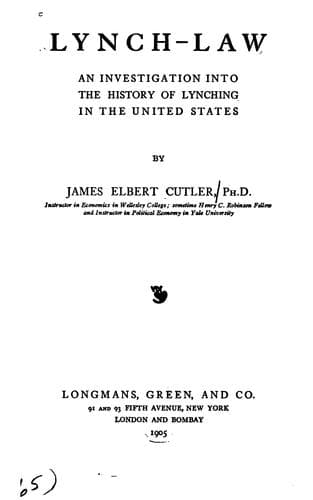
Lynch-law; an investigation into the history of lynching in the United StatesCutler, James Elbert
Philosophy
Lynch-law; an investigation into the history of lynching in the United States
Cutler, James Elbert
Lynching -- United States
More than twenty persons were indicted in Vermilion County, Illinois,
for participation in the lynching of a negro at Danville on July 25,
1903, and verdicts of guilty of engaging in an attack on the county jail
were found against eleven men and one woman, the penalty being an
indeterminate sentence in the penitentiary.[312]
In January, 1903, twenty-eight white citizens of Attala County,
Mississippi, were indicted for the lynching of two negroes.[313]
In Alabama, in 1902, some men were given a term in the penitentiary for
lynching a negro, they being “the first like offenders,” according to
Governor Jelks, “to serve the state since the great war. No man had
heretofore gone to the penitentiary for lynching a negro.”[314]
On June 4, 1903, Samuel Mitchell, white, who led the mob that lynched
Thomas Gilyard, a negro, at Joplin, Missouri, on April 15, preceding,
was sentenced to ten years’ imprisonment in the penitentiary, and two
other men were still to be tried for their part in the burning of negro
houses following the lynching.[315]
In California nineteen indictments were returned against persons who
engaged in the lynching of four men and a boy on May 31, 1901, at
Lookout, in Modoc County, and it was said that the State’s attorney
worked up the case against great opposition.[316]
There were several persons under indictment in Wyoming in February,
1904, for connection with a lynching which occurred in Big Horn County
on July 19, 1903.[317]
No convictions of persons participating in lynchings in either
Tennessee, Kentucky, or Texas have been brought about under the
anti-lynching laws which were enacted by those States in 1897.[318] The
case of the State _vs._ Hughes, charged with participating in a
lynching, came up in DeKalb County, Tennessee, in July, 1902, but it was
found impossible to get a jury to try the case. The court exhausted a
venire of three hundred and fifty, and “found every man in the lot
disqualified—probably having themselves aided in the affair.”[319] On
November 13, 1902, John Davis, colored, was lynched in Marshall County,
Tennessee. Two men, W. P. Hopwood and W. H. L. Johnson, were later
arrested on the charge of participating in the lynching. On January 7,
1903, thirty masked men appeared at the jail where the prisoners were
confined, obtained the keys to the jail, and released the
prisoners.[320]
Public-domain text, read in full here on John Shaqi.
Reviews
Reviews
No reviews yet
Be the first to share your thoughts on this work.
Elsewhere in the archive
Join the Discussion
Join the discussion
Sign in to leave a comment or review.
Sign InorCreate an account