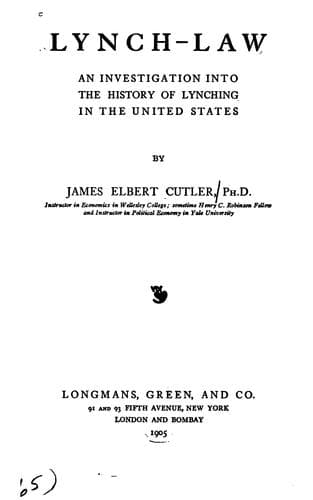
Lynch-law; an investigation into the history of lynching in the United StatesCutler, James Elbert
Philosophy
Lynch-law; an investigation into the history of lynching in the United States
Cutler, James Elbert
Lynching -- United States
The measures adopted by Georgia and North Carolina for the suppression
of lynchings have likewise remained inoperative. Numerous lynchings have
taken place in both of these States since 1893, but no lyncher has yet
suffered any of the penalties prescribed by law. A resident of North
Carolina recently made this statement with reference to the punishment
of lynchers in his State: “Judges have charged juries against the crime,
and Governor Aycock—risking his political fortunes for his
convictions—recently offered a reward of $400 each for the conviction of
a party of seventy-five who lynched a negro near Salisbury. But never
yet has the law punished a North Carolina lyncher.”[321]
In general it may be said that the laws proposed far outnumber the laws
enacted against lynching, and that wherever such laws have been enacted
their enforcement has not as yet been such as to warrant any great
reliance on their effectiveness to prevent lynching. It can scarcely be
said that the remedy for lynching lies at present in the direction of
additional State legislation specifically directed against it.
By many it is thought that a federal law on the subject would be most
effective in the suppression of lynchings, and several bills have been
introduced in Congress with this end in view.[322] On January 13, 1902,
Mr. Crumpacker of Indiana introduced a bill in the House of
Representatives for the punishment of persons taking part in the
lynching of aliens. The bill was designed to cover cases similar to the
lynching of the Italians at New Orleans, and jurisdiction over such
offenses was given to the federal courts, persons who had taken part in
lynchings being disqualified from serving as jurors.[323]
Others would have Congress enact a law making all who lynch, whether the
victims be citizens or aliens, and all who instigate, aid, abet, or
shield lynchers, guilty of a crime against the United States. In support
of such a law it is urged that a lyncher could be as easily discovered
and punished as a moonshiner, or a counterfeiter, or a mail robber; that
if the object of our constitution is to insure domestic tranquility,
promote the general welfare and secure the blessings of liberty to
ourselves and our posterity, it ought to include the power to punish
those who defy the government established by the constitution and take
life without due process of law; and that if it was worth while to amend
the constitution to prevent the denial of the electoral franchise, it is
also worth while to amend the constitution to prevent and punish the
denial of justice.[324]
Public-domain text, read in full here on John Shaqi.
Reviews
Reviews
No reviews yet
Be the first to share your thoughts on this work.
Elsewhere in the archive
Join the Discussion
Join the discussion
Sign in to leave a comment or review.
Sign InorCreate an account