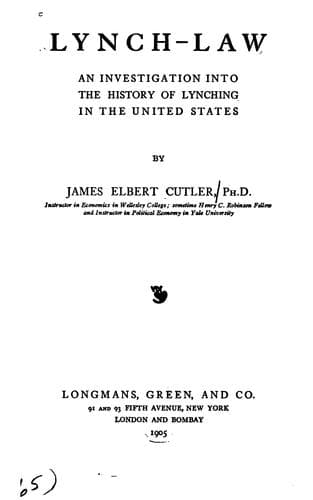
Lynch-law; an investigation into the history of lynching in the United StatesCutler, James Elbert
Philosophy
Lynch-law; an investigation into the history of lynching in the United States
Cutler, James Elbert
Lynching -- United States
It is a peculiar situation when the United States can thus be called
upon to pay indemnities for lynchings and yet cannot take steps in the
several States to prevent their occurrence and cannot in any way hold
the State governments responsible. That this defect in the federal
constitution should be remedied seems, from this standpoint, wholly
desirable. It is very doubtful, however, whether such an object could be
accomplished at the present time, and still more doubtful whether a
federal law could be enacted and enforced against lynching at the
present time, without reviving the sectionalism and many of the evils of
the Reconstruction Period. When Senator Gallinger of New Hampshire
offered a resolution in the 57th Congress that the Committee on the
Judiciary be directed to make an inquiry into the subject of lynchings
and to report whether there be any remedy for the evil, his reference to
a recent lynching in a Southern State was instantly resented by the
senators from that State, and the course which the debate took upon the
resolution made it apparent at once that an attempt to make such an
investigation would be an unwise step. The matter was dropped by Senator
Gallinger’s making the request that the resolution lie on the table
subject to his call.[329]
Of the numerous proposals that have been made for reform in the system
of legal procedure in the United States, as a remedy for lynching, none
is more noteworthy or fundamental than that put forward by Justice
Brewer of the United States Supreme Court. He argues that men are afraid
of the law’s delays and the uncertainty of its results; that if all were
sure that the guilty ones would be promptly tried and punished, the
inducement to lynch would be largely taken away. He suggests, therefore,
the taking away of the right of appeal in criminal cases as one means of
checking lynching.[330]
Public-domain text, read in full here on John Shaqi.
Reviews
Reviews
No reviews yet
Be the first to share your thoughts on this work.
Elsewhere in the archive
Join the Discussion
Join the discussion
Sign in to leave a comment or review.
Sign InorCreate an account