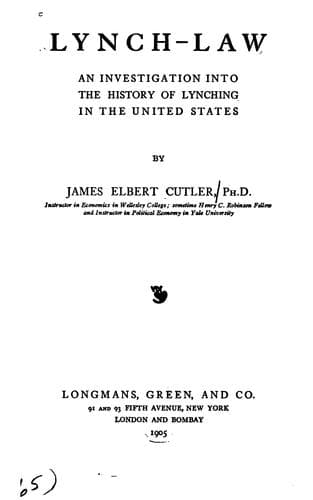
Lynch-law; an investigation into the history of lynching in the United StatesCutler, James Elbert
Philosophy
Lynch-law; an investigation into the history of lynching in the United States
Cutler, James Elbert
Lynching -- United States
While the law’s delays in criminal cases are probably not so great as
they are popularly believed to be, the popular impression being due to
over-emphasis of flagrant cases,[331] still the fact that such an
impression is a prevalent one makes it extremely easy for a community to
countenance the summary and illegal punishment of the perpetrator of a
crime which has been particularly shocking to the community, a crime for
which many persons in the community really feel that no punishment can
be quite adequate. A case in point is that of the lynching of George
White, colored, at Wilmington, Delaware, on June 22, 1903. A refusal by
the judges to grant an immediate trial on the ground that the accused
could not then have a fair and impartial trial because of the excited
state of public feeling, was publicly urged as a reason for the people
taking the law into their own hands and “upholding the majesty of the
law.” The outcome was that White was burned at the stake and those who
participated in the lynching were allowed to go free, the coroner’s jury
returning a verdict that the deceased came to his death at the hands of
persons unknown.
It is in this way that the popular idea that the law’s delays are so
great as frequently to defeat the ends of justice, whether it have much
or little basis in fact,[332] contributes to the continuance of the
practice of lynching. If to abolish the right of appeal in criminal
cases, or to limit it to a considerable extent, will further the ends of
justice, as there seems to be good reason for believing that it will,
such a step will have a tendency to check lynching by making void one of
the excuses most frequently urged in extenuation of the practice.
Lynching is a phenomenon in American society too deeply rooted to be
destroyed by merely taking away the right of appeal in criminal cases,
but that a measure will render less plausible a prominent excuse for its
existence and continuance makes such a measure worthy of serious
consideration.
Public-domain text, read in full here on John Shaqi.
Reviews
Reviews
No reviews yet
Be the first to share your thoughts on this work.
Elsewhere in the archive