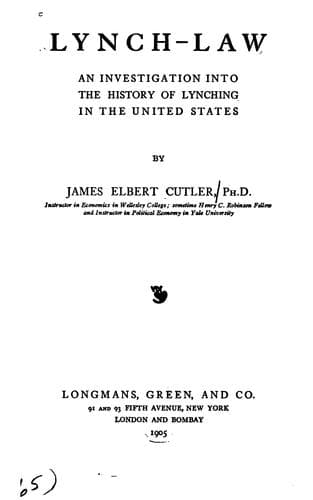
Lynch-law; an investigation into the history of lynching in the United StatesCutler, James Elbert
Philosophy
Lynch-law; an investigation into the history of lynching in the United States
Cutler, James Elbert
Lynching -- United States
In December, 1899, Richard Coleman, a negro ravisher and murderer, was
burned at the stake at Maysville, Kentucky. In response to a letter from
the governor of the State, asking for particulars, a Maysville lawyer
wrote as follows: “The whole thing took place in broad daylight and in
the presence of thousands. The parties to it are known, Mr. Lashbrook
(husband of Coleman’s victim) himself being the leader, but it will be
fruitless to attempt any prosecution of them. The people of this
community are as good as the people of any other community in the State,
or, for that matter, elsewhere, and they are shocked, and, I may say,
well-nigh paralyzed by this gruesome happening in their midst, but I am
satisfied they will not take kindly to any attempt to hold the parties
to the transaction to any responsibilities therefor.”[339]
The only ultimate remedy for lynching is a strong public sentiment
against it. It is necessary, in the United States particularly, to
depend very largely upon public sentiment for the enforcement of law,
and until there is a sentiment, in every community where a lynching
occurs, which will demand the punishment of those who take part in such
lynching, it can scarcely be expected that sheriffs will risk their
lives to protect prisoners, or that prosecuting attorneys, judges, and
juries will co-operate to secure the conviction of lynchers and to make
them feel the full penalty of the law. A member of the Maryland Bar
writing in 1900 said that less than a dozen lynchers had ever been tried
for their crime, and only one or two had been punished. The present
writer has been able to obtain no information which would warrant the
statement that as many as twenty-five persons have been convicted of a
crime and punished for participating in the lynching of over three
thousand persons in the last twenty-two years.[340]
From the greater number of indictments that have been secured against
lynchers during the last two years it would seem that the practice of
lynching is receiving stronger public condemnation now than formerly,
but it must be remembered that the creation of a public sentiment on any
subject is a slow process, particularly with reference to lynching.
Lynching as a crime against society is not yet distinguished from
lynching as the justifiable infliction of a deserved punishment by
private citizens. Furthermore, it is difficult to create a public
sentiment against lynching because of the racial antipathy which
aggravates the evil in certain sections of the United States. Time will
be required for the effectual application of a remedy for lynching. Any
anti-lynching measures that may be adopted must be considered as
palliatives rather than as remedies.
Public-domain text, read in full here on John Shaqi.
Reviews
Reviews
No reviews yet
Be the first to share your thoughts on this work.
Elsewhere in the archive
Join the Discussion
Join the discussion
Sign in to leave a comment or review.
Sign InorCreate an account