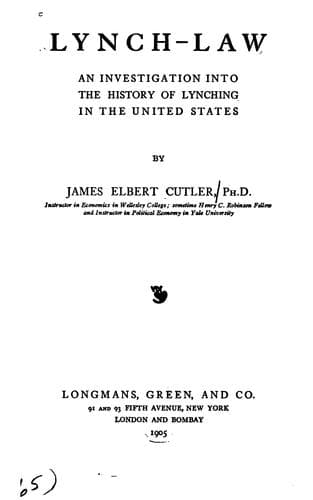
Lynch-law; an investigation into the history of lynching in the United StatesCutler, James Elbert
Philosophy
Lynch-law; an investigation into the history of lynching in the United States
Cutler, James Elbert
Lynching -- United States
No single statute can be enacted which will put an end to the practice
of lynching; nor is it likely that any single measure can be adopted
which will effectually suppress lynching. Every measure which will tend
to invalidate the excuses offered for the adoption of lynch-law
procedure, every measure which will tend to prevent the commission of
crimes provoking resort to lynch-law procedure, every measure which will
tend to strengthen and maintain a popular reliance on legal procedure,
every measure which will in any way tend to create a strong,
uncompromising public sentiment against lynching, all of these must be
adopted if the practice of lynching is to be made a thing of the past in
the United States.
CHAPTER IX
SOME CONCLUSIONS
The question naturally arises, what is the peculiarity about American
society which fosters and tolerates lynching? Why is lynching a
peculiarly American institution? It has been suggested that the
explanation lies along racial lines. Some have said that the
Scotch-Irish are responsible for the introduction into this country of
the practice of illegally punishing public offenders. Others say that it
is race prejudice, a result of the coming together of many races in one
country, and particularly that it is the racial antagonism between the
white race and the negro race, which explains the matter. Looking at the
history of the practice in the United States from colonial times down to
the present day, one can scarcely regard such an explanation as either
adequate or conclusive. The real explanation lies along a somewhat
different line, and it can be pointed out best by drawing some contrasts
between the administration of the law in the United States and its
administration in the older countries of Europe.
The American people are not any more disposed toward lawlessness—they
are not less law-abiding—than European peoples; it is rather that they
maintain a wholly different attitude toward the law. Social and
political conditions are different, and the law, instead of being
something in itself to reverence and respect, is little more than a
device for securing freedom. The value of laws as rules of conduct is
not minimized but there is no sense of sanctity pertaining to them. To
outwit, avoid, defy, or forget the laws is not a serious offense so long
as an appeal can be made to the individual sense of justice in support
of such courses of action.
Public-domain text, read in full here on John Shaqi.
Reviews
Reviews
No reviews yet
Be the first to share your thoughts on this work.
Elsewhere in the archive
Join the Discussion
Join the discussion
Sign in to leave a comment or review.
Sign InorCreate an account