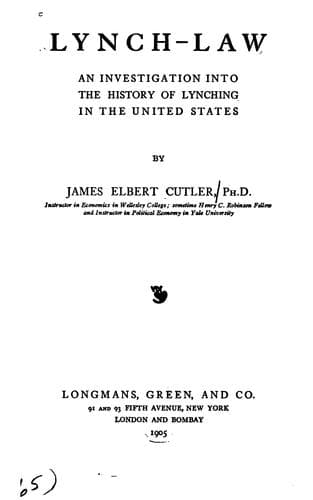
Lynch-law; an investigation into the history of lynching in the United StatesCutler, James Elbert
Philosophy
Lynch-law; an investigation into the history of lynching in the United States
Cutler, James Elbert
Lynching -- United States
The lynching of negroes is now so distinctively an American practice
largely because of the racial contrast in the population which is
peculiar to this country. Nowhere else in the temperate zone does a
colored race of tropical origin come into contact in such numbers with a
highly civilized race of European stock. The “native question” of
tropical regions has here been transplanted, as it were, to the
temperate zone.[345] Furthermore, the difficulties arising from ethnic
contact within the tropics have been intensified rather than lessened by
this change of environment. There are the same fundamental differences
in racial characteristics and in racial heredity, but these become
accentuated and seem even more adverse in a climate where the struggle
for existence is of necessity much more vigorous and exacting. In
addition, there has developed between the white race and the colored
race in the United States an intolerant, inconsiderate spirit directly
promoted by an unwise and short-sighted political policy. A great many
years will doubtless be required for the effacement of the unfortunate
results of past errors, involving as it does a very general
understanding and recognition of the ethnic and “societal” factors which
enter vitally into the “race question.” Only in so far as this comes
about, however, will it be possible to establish a new order of society
with an appropriate legal system in the place of that which formerly
existed on the basis of the institution of slavery.
The assumption made by many writers that more negroes are lynched for
the crime of rape against white women than for any other crime is
without foundation in fact. Statistics show that not more than
thirty-four per cent of the negroes summarily put to death during the
last twenty-two years have been lynched for that crime, either alleged,
attempted, or actually committed. Lynching for that crime, however,
leads to lynching for other crimes and also furnishes a ground for an
appeal to public sentiment to condone the practice of lynching.
Public-domain text, read in full here on John Shaqi.
Reviews
Reviews
No reviews yet
Be the first to share your thoughts on this work.
Elsewhere in the archive
Join the Discussion
Join the discussion
Sign in to leave a comment or review.
Sign InorCreate an account