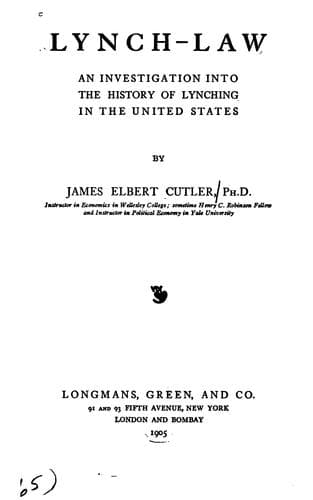
Lynch-law; an investigation into the history of lynching in the United StatesCutler, James Elbert
Philosophy
Lynch-law; an investigation into the history of lynching in the United States
Cutler, James Elbert
Lynching -- United States
While the decrease in the number of lynchings per year since the early
nineties affords some hope for the future with reference to the
suppression of lynchings, still the number of burnings and the number of
cases in which the victims are subjected to extreme torture indicate
that too much reliance cannot be placed upon any apparent decline in the
tendency to lynch. The fact also that lynchings frequently occur in
communities where such summary and illegal procedure had not previously
been permitted forebodes more lynchings in the future. The seriousness
of the situation with reference to the practice of lynching in the
United States is not yet fully realized. There is no little ground for
apprehension in the fact that it is becoming common for cries of “Lynch
him,” “Hang him,” “Get a rope and string him up,” &c., to be heard, even
on the streets of New York City, whenever a crowd gathers in response to
a feeling of popular excitement and indignation over the perpetration of
some atrocious crime.
In the course of this investigation into the history of lynching it has
become evident that there is usually more or less public approval, or
supposed favorable public sentiment, behind a lynching. Indeed, it is
not too much to say that popular justification is the _sine qua non_ of
lynching. It is this fact that distinguishes lynching, on the one hand,
from assassination and murder, and, on the other hand, from insurrection
and open warfare. A lynching may be defined as an illegal and summary
execution at the hands of a mob, or a number of persons, who have in
some degree the public opinion of the community behind them. When the
term first came into use it meant the infliction of corporal punishment,
particularly whipping. The term is now used exclusively to signify the
infliction of the death penalty in a summary fashion, usually by
hanging. But whatever the penalty imposed or the manner of its
imposition, the sentiment frequently expressed in a community where a
lynching has occurred is to the effect that the victim or victims got no
more than was deserved.
It further appears from this investigation that no one cause or crime
can be assigned for lynching. Lynchings take place for various causes.
At one time there may be a lack of ordinary tribunals of justice, at
another time there may be doubt as to the efficiency of the legal
machinery. Lynchings may take place because the offense is outside the
law but is deemed serious enough to merit severe punishment. They may
occur because of the barbarity and fiendish nature of the crime
committed. They may occur for one reason or for another; the only factor
that is always present is a disorganized state of society or a condition
of popular excitement and resentment when reliance on ordinary legal
procedure is at a minimum.
Public-domain text, read in full here on John Shaqi.
Reviews
Reviews
No reviews yet
Be the first to share your thoughts on this work.
Elsewhere in the archive
Join the Discussion
Join the discussion
Sign in to leave a comment or review.
Sign InorCreate an account