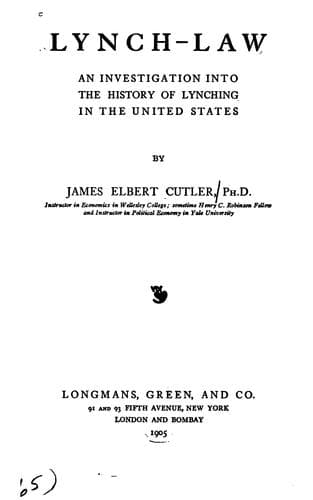
Lynch-law; an investigation into the history of lynching in the United StatesCutler, James Elbert
Philosophy
Lynch-law; an investigation into the history of lynching in the United States
Cutler, James Elbert
Lynching -- United States
Of the legal remedies for lynching which have been proposed, few have
been enacted into laws, and where such measures have been placed upon
the statute-books they have not as yet been so effectively administered
as to inspire confidence in them as an ultimate means of suppressing the
practice. The problem of finding a remedy for lynching is really a
problem of increasing and maintaining a popular reliance on the
formulation and the administration of the law. Every measure which will
in any way promote such a reliance, either by invalidating the excuses
offered in justification of the practice or by developing a strong
public sentiment against it, deserves serious consideration, and every
such measure, unless likely to be productive of other evils possibly
greater, should be immediately adopted and put into operation.
The existence of the practice of lynching in the United States is a
national disgrace and should be so considered by every citizen no matter
in what part of the country his home may be. This, however, does not
justify citizens of the Northern section in violently attacking citizens
of the Southern section every time that a lynching occurs in that
section, or _vice versa_. Each section and indeed each community must
hold itself responsible for the prevention of lynchings. Neither
European philanthropists nor the Northern press or pulpit can do very
much toward preventing such occurrences in the South. It is a question
with which the South alone can properly deal and it is a problem which
the intelligent men of the South are best able to solve. The efforts of
the Southern Education Board and the General Education Board to educate
both the whites and the blacks and lift them to a higher plane of living
will do much toward preventing lynchings. The work done by such schools
as the Hampton Institute and the Tuskegee Normal and Industrial
Institute, and the principles advocated by such men as Booker T.
Washington, also lead in the same direction.
It has been well suggested that the Northern papers and the Southern
papers should exchange texts—the Northern press should preach against
negro crime, the Southern press should preach against lawlessness and
race prejudice. That this has been done in a few instances gives hope
for the future.
To the extent that the colored race increases its industrial efficiency
and becomes economically strong in the South will there be a decrease in
negro lawlessness and viciousness, and likewise will it merit respect
and confidence on the part of the white race. More than anything else
the colored race needs wise and able leaders at the present time. The
false notions and ideals of the Reconstruction Period have now been
largely eradicated. The race is in a position to make substantial and
material progress, if under able leadership, and such progress will tend
to eliminate the conditions which foster lynching in the South.
Public-domain text, read in full here on John Shaqi.
Reviews
Reviews
No reviews yet
Be the first to share your thoughts on this work.
Elsewhere in the archive
Join the Discussion
Join the discussion
Sign in to leave a comment or review.
Sign InorCreate an account