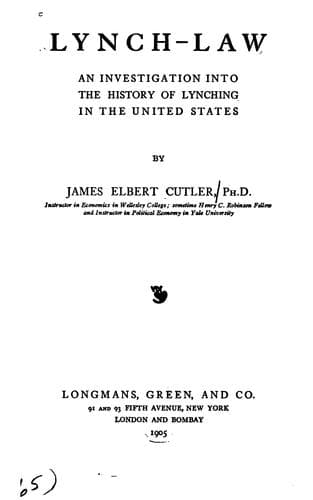
Lynch-law; an investigation into the history of lynching in the United StatesCutler, James Elbert
Philosophy
Lynch-law; an investigation into the history of lynching in the United States
Cutler, James Elbert
Lynching -- United States
If the United States had a monarchical form of government the most
practicable means for the suppression of lynchings would consist merely
in the publication of an edict by the monarch for the better enforcement
of the law. Most lynching mobs could be easily dispersed were the
officers of the law resolute and determined men intent upon protecting
their prisoners and letting the law take its course; if they were
responsible only to their superior officers and not more or less
directly responsible to the people, and if they were not in sympathy
with the mob to a greater or less degree. Our system of government,
however, is in form representative and popular, and all our traditions
are against a highly centralized form of government. In the United
States it is therefore necessary to depend very largely upon public
sentiment for a strict enforcement of the law. Lynch-law will not cease
to exist in this country until there is a strong and uncompromising
public sentiment against it in every community, a public sentiment
which, with a full recognition of the ethnic and “societal” factors
involved in the “race question,” and of the necessity for a legal system
consistent with these factors instead of one based on abstract
principles concerning the rights of all men, will invariably condemn
lynchings because they are a crime against society, if for no other
reason, and will under no circumstances countenance them because they
may be the administration of deserved and well-merited punishments.
LIST OF PERIODICALS CITED
Public-domain text, read in full here on John Shaqi.
Reviews
Reviews
No reviews yet
Be the first to share your thoughts on this work.
Elsewhere in the archive
Join the Discussion
Join the discussion
Sign in to leave a comment or review.
Sign InorCreate an account