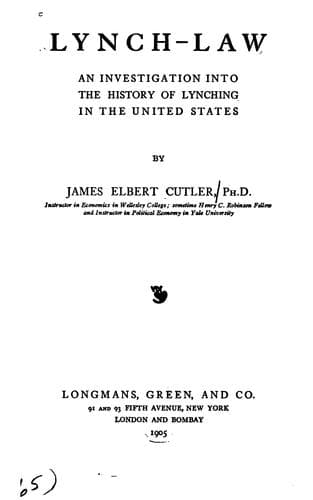
Lynch-law; an investigation into the history of lynching in the United StatesCutler, James Elbert
Philosophy
Lynch-law; an investigation into the history of lynching in the United States
Cutler, James Elbert
Lynching -- United States
See article by Edward McCrady, in the _Nation_, Jan. 15, 1903 (76:
52). This article as originally written was published in full in the
_Sunday News_, Charleston, S. C., Jan. 11, 1903. In a letter published
in the _Nation_, March 19, 1903 (76: 225), Mr. George S. Wills cites
an example of the use of the word lynch in connection with this creek,
which is found in a journal kept by the Rev. William H. Wills, a
Methodist minister of North Carolina, who traveled in his sulky from
Tarboro, North Carolina, to Alabama, in the early summer of 1837.
After describing a narrow escape from drowning in an attempt to cross
Lynch’s Creek while it was swollen, the Rev. Mr. Wills writes in his
journal: “Probably I shall never forget Lynches Creek; for it had well
nigh Lynch^d me.”—See “Publications of the Southern Historical
Association,” November, 1902 (6:479). This example, however, shows no
original connection between the term lynch-law and Lynch’s Creek,
South Carolina. As will appear in the following pages, by the year
1837 the word lynch had come to be widely used to indicate summary
punishment. Evidently the writer in this case merely noticed the
similarity between the name of the creek and the word which had
recently come into use, and so made this play upon words, using the
word lynch in a somewhat figurative sense.
Footnote 30:
See article by Albert Matthews in the _Nation_, Jan. 29, 1903 (76:
91). In a monograph by William A. Schaper, on “Sectionalism and
Representation in South Carolina,” the statement is made, in reference
to the Regulators of 1768, that “the settlers agreed to rely on lynch
law, which received its name at this time.”—Annual Report of the
American Historical Association (1900), I, 337. The author of this
statement that lynch-law received its name at this time was, however,
unable to cite facts to support it. (M.)
Footnote 31:
“History of the Old Cheraws” (1867), p. 128.
Footnote 32:
J. B. O’Neall: “Biographical Sketches of the Bench and Bar of South
Carolina” (1859), I, p. x.
Footnote 33:
“Traditions and Reminiscences,” pp. 44–45.
Footnote 34:
Ibid., p. 544.
Footnote 35:
Vol. 48, p. 402.
Footnote 36:
One such story will be found in the following chapter on p. 73. For an
account of the Lynch family in Virginia, see Mrs. Julia Mayo Cabell:
“Sketches and Recollections of Lynchburg” (1858), pp. 9–23. The chief
available sources of information for the facts and events pertaining
to the life of Charles Lynch are an article by Thomas Walker Page in
the _Atlantic Monthly_, December, 1901 (88: 731), and one by Howell
Colton Featherston in the _Green Bag_, March, 1900 (12: 150). Both of
these articles have been largely drawn upon in the following pages.
Footnote 37:
Public-domain text, read in full here on John Shaqi.
Reviews
Reviews
No reviews yet
Be the first to share your thoughts on this work.
Elsewhere in the archive
Join the Discussion
Join the discussion
Sign in to leave a comment or review.
Sign InorCreate an account