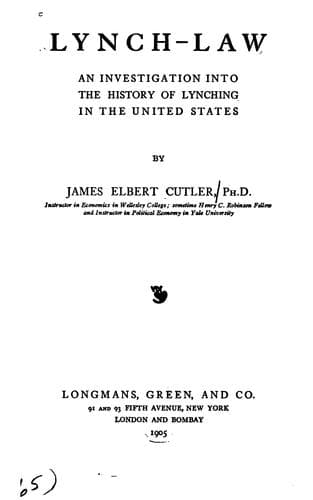
Lynch-law; an investigation into the history of lynching in the United StatesCutler, James Elbert
Philosophy
Lynch-law; an investigation into the history of lynching in the United States
Cutler, James Elbert
Lynching -- United States
A writer (“Claverhouse”) in the _New York Evening Post_ for June 2,
1864, says: “In America, the term ‘Lynch law’ was first used in
Piedmont, on the western frontier of Virginia. There was no court
within the district, and all controversies were referred to the
arbitrament of prominent citizens. Among these was a man by the name
of Lynch, whose decisions were so impartial that he was known as Judge
Lynch, and the system was called ‘Lynch law,’ and adopted in our
pioneer settlements as an inexpensive and speedy method of obtaining
justice.”
Footnote 38:
Edited by Benson J. Lossing, published in 1882.
Footnote 39:
See article by Arthur Desjardins, _Revue des Deux Mondes_, May, 1891.
Footnote 40:
Charles Lynch was born in 1736, at Chestnut Hill, his father’s estate,
upon a part of which the city of Lynchburg now stands. His father was
a “redemptioner” who came to Virginia from Ireland about 1725. The
young adventurer subsequently married the daughter of the planter to
whom the captain of the ship that brought him over had sold him, took
up a large tract of land lying between the James and the Staunton
rivers, and became a tobacco planter on a large scale. At his death
the home on the James fell to his eldest son, John, and Charles took
the part of the family lands that lay nearer the frontier. The mother,
Sarah Lynch, then a widow, had joined the sect of the Quakers at the
Cedar Creek meeting on April 16, 1750, and it is in the records of
this congregation of Quakers that the following item appears: “14 of
Dec., 1754. Charles Lynch and Anne Terrill published for the first
Time their Intentions of Marriage.” The young couple established their
home on the Staunton, in what is now the southwestern part of Campbell
County.
Public-domain text, read in full here on John Shaqi.
Reviews
Reviews
No reviews yet
Be the first to share your thoughts on this work.
Elsewhere in the archive
Join the Discussion
Join the discussion
Sign in to leave a comment or review.
Sign InorCreate an account