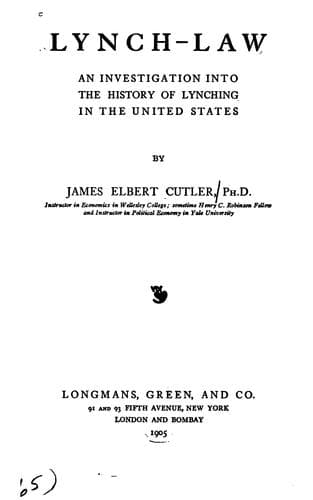
Lynch-law; an investigation into the history of lynching in the United StatesCutler, James Elbert
Philosophy
Lynch-law; an investigation into the history of lynching in the United States
Cutler, James Elbert
Lynching -- United States
An act for dividing the county of Bedford into two distinct counties,
the new county to be known by the name of Campbell, was passed by the
General Assembly in 1782.—Hening’s Statutes at Large, X, 447; Journal
of the House of Delegates, Jan. 5, 1782, p. 73. Howe says that
Campbell County was formed from Bedford in 1784, and named in honor of
General William Campbell, a distinguished officer of the American
Revolution.—“Historical Collections of Virginia.” p. 210.
Footnote 52:
Published at Charleston, South Carolina, in 1845. See p. 212 for the
quotation. See Mrs. Julia Mayo Cabell: “Sketches and Recollections of
Lynchburg” (1858), pp. 9–10, for a similar account of the connection
of Colonel Charles Lynch with the origin of “the celebrated code
called ‘Lynch Law.’” This account is taken from the _St. Louis
Republican_, but neither the author’s name nor the date of its
publication is given.
Footnote 53:
Henry Howe: “The Great West” (Cincinnati, 1852), p. 183.
Footnote 54:
The writer is indebted to Mr. Matthews for the suggestion that Howe’s
allusion to “Squire Birch” points to Judge James Hall’s “Letters from
the West” as one such source. See Chapter III. p. 81.
Footnote 55:
There are two errors here. Lynchburg was not named for him but for his
brother, John Lynch, and the plan was started later than “some seventy
or eighty years ago.” Mr. Matthews disagrees with the writer in saying
that this account is entirely independent of what Wirt had written on
the subject. It seems to the writer, however, that these two
inaccuracies indicate that Martin was drawing wholly from his own
sources of information. He was, apparently, merely writing down what
was considered a matter of common knowledge among the older men in
that section of the country, many of whom were emigrants from
Virginia.
Footnote 56:
“Publications of the Southern Historical Association,” November, 1900,
(4: 463).
Footnote 57:
Charles Augustus Murray, in his “Travels in North America during the
years 1834, 1835, and 1836” (2 vol., N. Y., 1839), gives a traditional
account of the origin of the term “lynch-law,” such a one as might be
given around a camp-fire. He also describes the operation of lynch-law
at that time in the Mississippi Valley. See Vol II, p. 79. G. W.
Featherstonhaugh, in his “Excursion through the Slave States” (N. Y.,
1844), gives “An account of the first Judge Lynch, and the state of
Legal Practice in his Court,” pp. 89–90. He speaks of a certain Judge
Lynch in Arkansas and of “a famous Virginia ancestor of his.” He says
that “this ancestor, the first Judge Lynch, was a miller and a justice
of the peace in the back woods,” and then gives a traditional account
of his methods of inflicting punishment. See also David Schenck:
“North Carolina, 1780–81” (1889), pp. 309–310. L. P. Summers: “History
of Southwest Virginia and Washington County” (1903), p. 243.
Footnote 58:
Public-domain text, read in full here on John Shaqi.
Reviews
Reviews
No reviews yet
Be the first to share your thoughts on this work.
Elsewhere in the archive
Join the Discussion
Join the discussion
Sign in to leave a comment or review.
Sign InorCreate an account