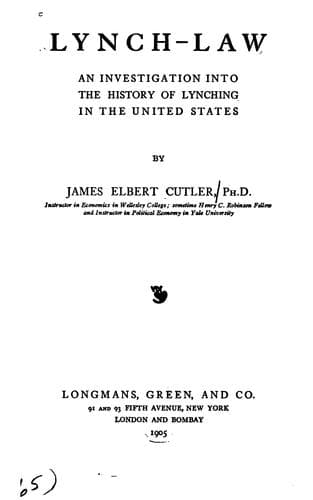
Lynch-law; an investigation into the history of lynching in the United StatesCutler, James Elbert
Philosophy
Lynch-law; an investigation into the history of lynching in the United States
Cutler, James Elbert
Lynching -- United States
“The infliction of capital punishment was extremely rare. There were
only three instances of it, and these for most heinous offenses,
between the organization of the county (Bedford) and the Revolution.
The first case was on May 24, 1756, when the court assembled ‘to hear
and determine all Treasons, Petit Treasons, Murders, and other
Offenses committed or done by Hampton and Sambo belonging to John
Payne of Goochland, Gent.’ ‘The said Hampton and Sambo were set to the
Bar under Custody of Charles Talbot (then sheriff) to whose Custody
they were before committed on Suspicion of their being Guilty of the
felonious Prepairing and Administering Poysonous Medicines to Ann
Payne, and being Arraigned of the Premises pleaded Not Guilty and for
their Trial put themselves upon the Court. Whereupon divers Witnesses
were charged and they heared in their Defence. On Consideration
thereof it is the Opinion of the Court that the said Hampton is guilty
in the Manner and Form as in the Indictment. Therefore it is
considered that the said Hampton be hanged by the Neck till he be
dead, and that he be afterwards cut in Quarters, and his Quarters hung
up at the Cross Roads. And it is the Opinion of the Court that the
said Sambo is guilty of a Misdemeanor. Therefore it is considered that
the said Sambo be burnt in the Hand, and that he also receive
thirty-one Lashes on his bare Back at the Whipping Post. Memo: That
the said Hampton is adjudged at forty-five Pound which is ordered to
be certified to the Assembly (that his owner may be remunerated
according to law).’ That it was a convincing proof of his guilt, and
not race prejudice, that led the court to impose this savage
punishment is evident from the fact that in the same year a negro was
tried for murder, another for poisoning, and a third for arson, and
all were cleared.”—Quoted from the article by Mr. Page.
Footnote 49:
This evidence has been presented by the present writer in a
communication to the _Nation_. See issue of May 21, 1903 (76: 415).
Footnote 50:
William Wirt: “Sketches of the Life and Character of Patrick Henry”
(1818), p. 372. Mr. Matthews, in his article in the _Nation_, Dec. 4,
1902 (75: 439), remarks that it is uncertain whether the note was
written by Roane or Wirt. In William Wirt Henry’s “Life of Patrick
Henry,” Vol. II, p. 482, the “MS. Letter of Judge Roane to Mr. Wirt”
is given, but the note is not included. The note was undoubtedly
written by Wirt.
Footnote 51:
Public-domain text, read in full here on John Shaqi.
Reviews
Reviews
No reviews yet
Be the first to share your thoughts on this work.
Elsewhere in the archive
Join the Discussion
Join the discussion
Sign in to leave a comment or review.
Sign InorCreate an account