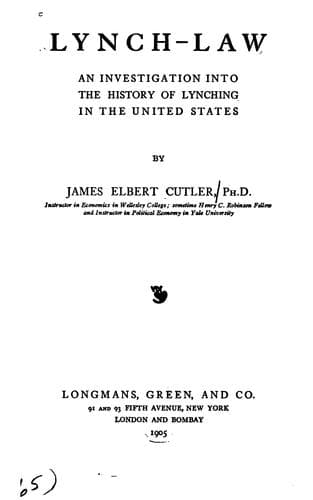
Lynch-law; an investigation into the history of lynching in the United StatesCutler, James Elbert
Philosophy
Lynch-law; an investigation into the history of lynching in the United States
Cutler, James Elbert
Lynching -- United States
See Gregg’s “History of The Old Cheraws,” p. 139.
Footnote 86:
David Ramsay: “History of the Revolution in South Carolina” (1785), I,
63–64. According to this author these events took place “about the
year 1770.” O’Neall says (Annals of Newberry, p. 75): “The Regulators
and Scofelites, in 1764, met in battle array,” &c. Johnson says
(Traditions and Reminiscences, p. 92): “In 1769 great commotions arose
in the upper parts of the State, between what were called ‘Regulators’
and ‘Schofilites.’” In reality, the crisis in the strife between the
Regulators and Schofilites occurred in March, 1769. This is shown by
the following extract, dated Charlestown, (South Carolina), April 6,
which appeared in the _Boston Chronicle_ of May 11–15, 1769 (No. 92,
II, 155): “The prudent conduct of government, in ordering Joseph
Coffill, who had assumed the title of Colonel, and some extraordinary
powers, and with his party had committed divers excesses, to disperse,
has had the happy effect of once more restoring peace and good order
amongst the inhabitants of the western settlements, who, exasperated
by the tyrannical conduct of this man, has assembled in a large body
towards the close of last month, in order to compel him to shew what
powers he was invested with, and if they had found that he was not
cloathed with authority, to have brought him to justice, at all
events. Both parties were incamped within musket shot of each other,
on Saludy river, when the orders to Coffill arrived, and thus a great
deal of bloodshed was prevented. The Colonels Richardson, Thompson,
and M’Girt, gentlemen of great reputation, and highly esteemed by the
whole body of honest back settlers, we are told, exerted themselves
upon this occasion, with great spirit, discretion, and success.”
Footnote 87:
Joseph Johnson: “Traditions and Reminiscences” (1851), p. 45.
Footnote 88:
Ibid.
Footnote 89:
See Gregg’s “History of the Old Cheraws,” pp. 151–152.
Footnote 90:
This is likewise Gregg’s view of the matter.
Footnote 91:
Public-domain text, read in full here on John Shaqi.
Reviews
Reviews
No reviews yet
Be the first to share your thoughts on this work.
Elsewhere in the archive
Join the Discussion
Join the discussion
Sign in to leave a comment or review.
Sign InorCreate an account