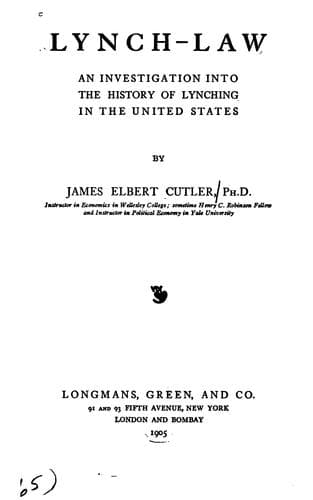
Lynch-law; an investigation into the history of lynching in the United StatesCutler, James Elbert
Philosophy
Lynch-law; an investigation into the history of lynching in the United States
Cutler, James Elbert
Lynching -- United States
Footnote 128:
W. N. Blane: “An Excursion through the United States and Canada,
1822–1823” (London, 1824), pp. 233–236.
Footnote 129:
See pp. 291–292 for this extract. The letters which compose Judge
Hall’s book were mostly printed in _The Port Folio_ between 1821 and
1825, but the letter in which he speaks of lynch-law first appeared in
the printed volume of 1828. (M.)
Footnote 130:
This expression is used in the Illinois agreement of 1820 (see below),
and that document, if genuine, furnishes the earliest instance of its
use known to the present writer.
Footnote 131:
This statement is made on the authority of McConnel (see below), but
compare C. J. Latrobe: “Ramble in America,” (N. Y., 1836, 2d ed.),
Let. VII, I, 96.
Footnote 132:
J. L. McConnel: “Western Characters or Types of Border Life in the
Western States” (1853), pp. 244–245. (M.) This extract is copied
verbatim, the names of the twelve men being omitted by McConnel. Of
the genuineness of the document McConnel says: “I am not sure that I
can vouch for its authenticity, but all who are familiar with the
history of those times, will recognise, in its peculiarities, the
characteristics of the people who then inhabited this country. The
affectation of legal form in such a document as this would be rather
amusing, were it not quite too significant; at all events, it is
entirely ‘in keeping’ with the constitution of a race who had some
regard for law and its vindication, even in their most high-handed
acts. The technical phraseology, used so strangely, is easily
traceable to the little ‘Justice’s Form Book,’ which was then almost
the only law document in the country; and though the words are rather
awkwardly combined, they no doubt gave solemnity to the act in the
eyes of its sturdy signers.”
Footnote 133:
J. L. McConnel: “Western Characters,” &c., p. 176.
Footnote 134:
_Niles’ Register_, July 19, 1834 (46: 352).
Footnote 135:
The _Liberator_, Nov. 5, 1831 (1: 180).
The publication of this paper was begun in Boston in 1831, by William
Lloyd Garrison, the enthusiastic agitator of the anti-slavery cause.
His efforts to make his lists of “Southern Atrocities” as large as
possible render his paper a valuable source of information on the
subject of lynch-law, particularly lynch-law as applied to negroes
prior to the Civil War.
Footnote 136:
_Liberator_, Oct. 29, 1831 (1: 174).
Footnote 137:
Ibid., Oct. 1, 1831 (1: 157).
Footnote 138:
Ibid., Dec. 3, 1831 (1: 194).
Footnote 139:
For the fullest and, on the whole, most trustworthy account of this
insurrection, see W. S. Drewry: “Slave Insurrections in Virginia”
(1900). This book has been very largely drawn upon for what is here
said on the subject.
See also, _Liberator_, Oct. 1, 1831 (1: 159); Dec 10, 1831 (1: 198);
Dec. 17, 1831 (1: 202); Dec. 24, 1831 (1: 206).
Public-domain text, read in full here on John Shaqi.
Reviews
Reviews
No reviews yet
Be the first to share your thoughts on this work.
Elsewhere in the archive
Join the Discussion
Join the discussion
Sign in to leave a comment or review.
Sign InorCreate an account