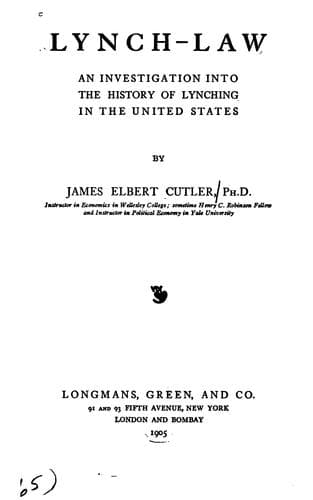
Lynch-law; an investigation into the history of lynching in the United StatesCutler, James Elbert
Philosophy
Lynch-law; an investigation into the history of lynching in the United States
Cutler, James Elbert
Lynching -- United States
See also, _Niles’ Register_, Aug. 27, 1831 (40: 455); Sept. 3, 1831
(41: 4); Sept. 10, 1831 (41: 19); Sept. 17, 1831 (41: 35); Jan. 7,
1832 (41: 350).
Footnote 140:
See p. 84 in Drewry’s book.
Footnote 141:
The slavery question was the subject of prolonged debate at the next
session of the Virginia House of Delegates. See _Niles’ Register_,
Jan. 28, 1832 (41: 393).
In a speech made during the course of this debate, William H. Broadnax
said: “I have certainly heard, if incorrectly, the gentleman from
Southampton will put me right, that of the large cargo of emigrants
lately transported from that county to Liberia, all of whom
_professed_ to be _willing_ to go, were rendered so by some such
severe ministrations as these I have described. A lynch club—a
committee of vigilance—could easily exercise a kind of inquisitorial
_surveillance_ over any neighborhood, and convert any desired number,
I have no doubt, at any time, into a willingness to be removed.” See
W. L. Garrison: “Thoughts on African Colonization” (1832), p. 74. This
reference comes to the present writer through Mr. W. P. Garrison and
Mr. Albert Matthews.
Footnote 142:
See _Niles’ Register_ for the year 1834.
Footnote 143:
_Liberator_, Oct. 18, 1834 (4: 168).
The _New England Magazine_, November, 1834 (7: 409), gives some
comments on the times under the heading “The March of Anarchy.”
Footnote 144:
_Liberator_, Sept. 27, 1834 (4: 153).
Footnote 145:
Conditions were apparently much like those which existed recently in
Memphis, Tennessee, when a Committee of Public Safety was organized
and a crusade started against gambling. See _New York Times_, July 14,
1904; July 17, 1904.
Footnote 146:
See _Niles’ Register_, July 25, 1835 (48: 363); Aug. 1, 1835 (48:
381). Also _Liberator_, Aug. 8,1835 (5: 126–7).
Footnote 147:
For a brief account of the conspiracy led by Murrell, see _Niles’
Register_, Aug. 8, 1835 (48: 403–4). A complete account may be found
in the _American Whig Review_, November, 1850 (12: 494); March, 1851
(13: 213).
Footnote 148:
See _Liberator_, Aug. 8, 1835 (5: 126–7).
Footnote 149:
The “South-West,” II, p. 185–7. In Mississippi, at this time, eleven
crimes were punishable by death.
Footnote 150:
See _Liberator_, Aug. 1, 1835 (5: 123).
Footnote 151:
_Boston Advertiser_, Sept. 12, p. 2.
Footnote 152:
Similar punishments have been inflicted upon Mormons. Joseph Smith,
Jr., and Sidney Rigdon were tarred and feathered on the night of March
25, 1832.—See W. A. Linn: “The Story of the Mormons” (1902), pp.
133–137.
Footnote 153:
Issue of Aug. 22, 1835 (48: 439).
Footnote 154:
Issue of Sept. 5, 1835 (49: 1).
Footnote 155:
See also Harriet Martineau “Society in America” (1837), I, 120, 121,
122.
Footnote 156:
_Niles’ Register_, Oct. 3, 1835 (49: 65).
Public-domain text, read in full here on John Shaqi.
Reviews
Reviews
No reviews yet
Be the first to share your thoughts on this work.
Elsewhere in the archive
Join the Discussion
Join the discussion
Sign in to leave a comment or review.
Sign InorCreate an account