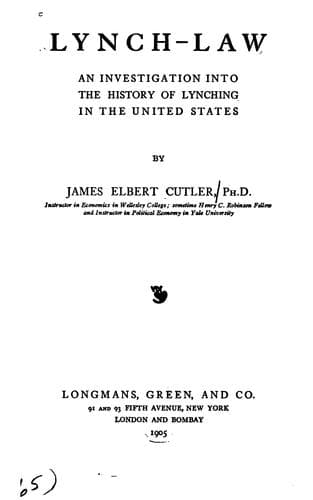
Lynch-law; an investigation into the history of lynching in the United StatesCutler, James Elbert
Philosophy
Lynch-law; an investigation into the history of lynching in the United States
Cutler, James Elbert
Lynching -- United States
Edward Leigh Pell, writing on “Prevention of Lynch-law Epidemics,” in
the _Review of Reviews_, March, 1898 (17: 321), questions the accuracy
of the _Tribune_ figures for Alabama, Florida, and Virginia in the
year 1897. It is to be noted, however, that he refers to lynchings and
seems to have regarded number of lynchings as synonymous with number
of persons lynched.
Footnote 208:
In a recent article, entitled “The Facts about Lynching,” written by
George P. Upton, who for a number of years has been associate-editor
of the _Tribune_, a similar table may be found. [See the
_Independent_, Sept. 29, 1904 (57: 719)]. In this table, however,
there are numerous inaccuracies, and the fact that Mr. Upton does not
discriminate between number of lynchings and number of persons lynched
detracts materially from the value of all of his statistical summaries
on the subject.
Footnote 209:
Compare p. 182.
Footnote 210:
The negro had escaped from the mob and gone to a neighboring county
where he gave himself up to the authorities for protection. Later,
according to a letter received by the writer from the mayor of the
town where he sought protection, he was taken back by the sheriff and
brought before a justice for a preliminary hearing. The evidence was
considered insufficient to bind him over to the grand jury and he was
released.
Footnote 211:
Principally New York City and New Haven, Conn., papers.
Footnote 212:
To be strictly accurate the number of lynchings should be taken rather
than the number of persons lynched, but for the purpose of comparison
from year to year the latter may be considered sufficiently exact. See
p. 185.
Footnote 213:
Henry M. Boies has shown from the _Tribune_ record of murders that
there has been, within the last twenty years, “an alarming increase of
homicides, accompanied by a proportionate decrease of executions by
law and lynching.”—“Science of Penology” (1901), p. 120.
Footnote 214:
See W. S. Drewry: “Slave Insurrections in Virginia” (1900), pp. 22–25.
Footnote 215:
The liberty has been taken of coining this word to designate the cause
for lynching the class of individuals known as desperadoes. No other
word seems to express the idea so clearly. The word “brigandage” is
too narrow in meaning and too nearly obsolete; the word “outlawry” is
not sufficiently inclusive and is generally used only in its technical
sense.
Footnote 216:
“Statistics and Sociology” (1900), p. 271.
Footnote 217:
This may be taken as an indication of the trustworthiness of the
_Tribune_ record of lynchings as a basis for statistical
investigation.
Footnote 218:
See p. 164.
Footnote 219:
See the daily issues from July 23 to July 27, 1886.
Footnote 220:
Public-domain text, read in full here on John Shaqi.
Reviews
Reviews
No reviews yet
Be the first to share your thoughts on this work.
Elsewhere in the archive
Join the Discussion
Join the discussion
Sign in to leave a comment or review.
Sign InorCreate an account