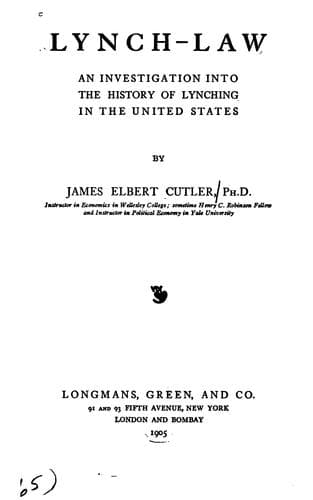
Lynch-law; an investigation into the history of lynching in the United StatesCutler, James Elbert
Philosophy
Lynch-law; an investigation into the history of lynching in the United States
Cutler, James Elbert
Lynching -- United States
A less valuable but an interesting book is “K. K. K. Sketches,” by J.
M. Beard, published at Philadelphia in 1877.
Many writers make incidental reference to the Ku-Klux Klan; for
example, Charles Stearns: “The Black Man of the South and the Rebels”
(1872), Chap. 39; James Bryce: “The American Commonwealth,” II, 479.
An account of “The Ku-Klux Movement” is given in W. G. Brown’s “Lower
South in American History” (1902).
Some of the characteristic, possibly exaggerated, features of the
“Ku-Klux Movement” have been presented in fiction. See, for example,
A. Conan Doyle: “Adventures of Sherlock Holmes, The Five Orange Pips”
(1902), p. 104; Thomas Nelson Page: “Red Rock, a chronicle of
Reconstruction” (1898).
Footnote 199:
The committee appointed to select a name reported among others the
name “Kukloi,” from the Greek word _kuklos_, meaning a band or circle.
At mention of this some one cried out: “Call it ‘Ku Klux.’” The word
“Klan” at once suggested itself, and was added to complete the
alliteration. It has been said that the society was named in imitation
of the click heard in cocking the rifle, but this seems to be without
foundation in fact.
Footnote 200:
See, for example, _Nation_, March 23, 1871 (12: 192); _New York
Times_, Feb. 15, 1871; _New York Times_, Aug. 26, 1873; _New York
Tribune_, July 31, 1878.
Footnote 201:
For a list of the “Molly Maguire” outrages in the mining region of
Pennsylvania, and for an exposition of the origin, growth, and
character of that organization, see F. P. Dewees: “The Molly Maguires”
(1877).
Footnote 202:
No claim for completeness is made in regard to these statistics.
Particularly in the case of lynchings in the West they are doubtless
incomplete.
Footnote 203:
_Outlook_, Dec. 26, 1903 (75: 984).
Footnote 204:
Compare the opinion expressed in the _Nation_, Sept. 7, 1876 (23: 145)
on the subject of “intimidation” at the South. In the year 1879, a
“Negro exodus from the Southern States” took place, which, on account
of its size and character, attracted considerable attention. Numerous
reasons were assigned as the cause. See F. L. Hoffman: “Race Traits
and Tendencies of the American Negro.”—Publications of the American
Economic Association, August, 1896 (11: 1); _Nation_, April 10, 1879
(28: 239, 242); Report and Testimony of the Select Committee of the U.
S. Senate to investigate the causes of the removal of the negroes from
the Southern States to the Northern States, 2d Sess., 46th Cong.
(Washington, 1880).
Footnote 205:
It is of interest to note that the Sons of Liberty of the period
1765–1775 seem to have had a regular organization and that in their
use of disguises and in their methods they were not wholly unlike the
Ku-Klux.
Footnote 206:
“Lynching and Mobs,” _American Journal of Social Science_, No. 32, p.
67 (November, 1894).
Footnote 207:
Public-domain text, read in full here on John Shaqi.
Reviews
Reviews
No reviews yet
Be the first to share your thoughts on this work.
Elsewhere in the archive
Join the Discussion
Join the discussion
Sign in to leave a comment or review.
Sign InorCreate an account