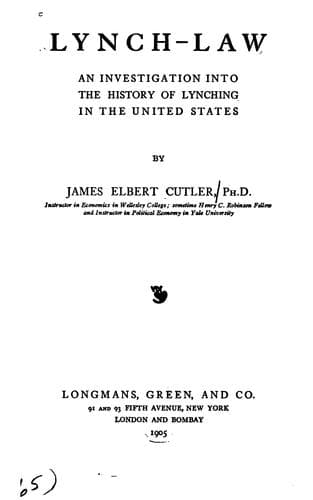
Lynch-law; an investigation into the history of lynching in the United StatesCutler, James Elbert
Philosophy
Lynch-law; an investigation into the history of lynching in the United States
Cutler, James Elbert
Lynching -- United States
Footnote 302:
Brown _v._ Orangeburg Co., 55 S. C. 45; 32 S. E. 764. The decision of
the Supreme Court was rendered on April 20, 1899.
Footnote 303:
See p. 235.
Footnote 304:
Mitchell was a negro and was lynched on June 4, 1897, for the crime of
rape.
Footnote 305:
Caldwell lost again in the common pleas and circuit courts, and went
no further.—Deputy Clerk of Cuyahoga County in letter to the writer.
Footnote 306:
See note, p. 236. The supreme court by this decision upheld the act in
its original form.
Footnote 307:
62 O. S. 318.
Footnote 308:
68 N. E. 899.
Footnote 309:
See p. 185. Compare Chart I.
Footnote 310:
_New York Times_, Jan. 21, 1904. Governor Sayers of Texas made similar
statements in his annual message to the legislature of Texas on Jan.
16, 1903.
Footnote 311:
_New York Times_, Nov. 3, 1903.
Footnote 312:
_New York Times_, Sept. 7, 1903.
Footnote 313:
_Richmond_ (Va.) _Planet_, Feb. 14, 1903.
Footnote 314:
Governor’s message to the legislature, Jan. 14, 1903.
Footnote 315:
_New York Evening Sun_, June 5, 1903.
Footnote 316:
After a trial which lasted three months, the first man tried was
acquitted.—_Denver_ (Colo.) _Republican_, Feb. 28, 1902.
Footnote 317:
Attorney-general of Wyoming in letter to the writer.
Footnote 318:
A woman whose husband was hanged by a mob has recently filed suit
against twenty-six “prominent citizens” of Fleming County, Kentucky,
for $50,000 damages, claiming that they were members of the mob which
lynched her husband.—_New York Times_, July 14, 1904.
Footnote 319:
_Chattanooga_ (Tenn.) _Times_, July 27, 1902. It will be remembered
that by the Tennessee act any person guilty of direct or indirect
participation in a lynching was declared to be incompetent to serve on
a jury, and that the court was to carefully exclude all such persons
from both grand and petit juries. See p. 237.
Footnote 320:
Despatch from Lewisburg, Tennessee, in _New York Commercial
Advertiser_, Jan. 8, 1903.
In October, 1903, a grand jury in Moore County, Tennessee, indicted
twenty-two members of a lynching mob.—See _Outlook_, Oct. 24, 1903
(75: 427).
Footnote 321:
_Atlantic Monthly_, February, 1904 (93: 155).
Footnote 322:
See bills introduced during 57th Congress, 1st Session: Senate Bill
1117; House bills 21, 4572.
Footnote 323:
_Congressional Record_, 57th Congress, 1st Session, p. 636.
Footnote 324:
See _Green Bag_, September, 1900 (12: 466).
Footnote 325:
_New York Tribune_, April 15, 1892.
Footnote 326:
Some of these indemnities cover loss of property and bodily injuries
as well as loss of life.
Footnote 327:
Public-domain text, read in full here on John Shaqi.
Reviews
Reviews
No reviews yet
Be the first to share your thoughts on this work.
Elsewhere in the archive
Join the Discussion
Join the discussion
Sign in to leave a comment or review.
Sign InorCreate an account