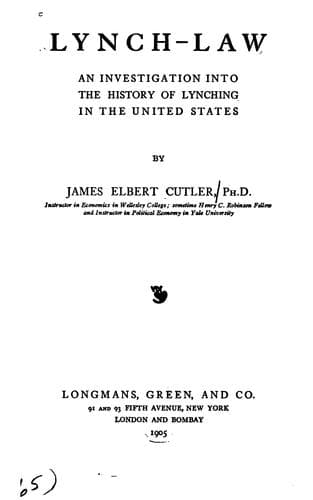
Lynch-law; an investigation into the history of lynching in the United StatesCutler, James Elbert
Philosophy
Lynch-law; an investigation into the history of lynching in the United States
Cutler, James Elbert
Lynching -- United States
See, in addition to _New York Tribune_, April 15, 1892, United States
Statutes at Large, 49th Cong., 2nd Sess., Ch. 253; 50th Cong., 1st
Sess., Ch. 1210; 54th Cong., 1st Sess., Ch. 373; 55th Cong., 1st
Sess., Ch. 9; 55th Cong., 2d Sess., Ch. 571; 56th Cong., 2d Sess., Ch.
831; 57th Cong., 2d Sess., Ch. 1006.
Footnote 328:
_American Law Review_, September-October, 1900 (34: 709).
Footnote 329:
See _Congressional Record_, 57th Congress, 1st Session, pp. 5902–5905,
5956, 6214.
Footnote 330:
_Leslie’s Weekly_, Aug. 20, 1903; _Independent_, Oct. 29, 1903 (55:
2547).
Footnote 331:
See _Harvard Law Review_, March, 1904 (17: 317).
Footnote 332:
On the work of the courts in the State of New York, see “Report of the
Commission on Law’s Delays,” January, 1904.
Footnote 333:
_Review of Reviews_, March, 1898 (17: 321).
Footnote 334:
Governor Newton C. Blanchard, at his inauguration on May 16, 1904, at
Baton Rouge, Louisiana, stated his position with reference to
lynchings in unmistakable language. “Lynchings,” he said, “will not be
permitted under any circumstances, if it be possible for the military
at the command of the Governor to get there in time to prevent them.
And if they occur before the intervention of the Executive can be made
effective, inquiry and investigation will be made and prosecution
instigated. Sheriffs will be held to the strictest accountability
possible under the law for the safety from mob violence of persons in
their custody.... The courts are adequate to the prompt vindication of
the law and the punishment of crime.”—_Outlook_, May 28, 1904 (77:
197).
Footnote 335:
Governor Vardaman ordered out two companies of militia and went
himself to the scene of the trouble in a special train, bringing the
negro away in his private car, at a cost to the State, it was said, of
$250,000. See _New York Times_, Feb. 29, 1904.
Footnote 336:
Vigilance and prompt action on the part of the officers of the law,
together with the presence of the militia, probably prevented the
lynching of the three negroes who assaulted Mrs. Biddle at Burlington,
New Jersey, on July 5, 1904.—See _New York Times_, July 16, 1904.
Footnote 337:
Governor Jelks, of Alabama, in his message of Jan. 14, 1903, said in
reference to the lynching in Pike County of a negro who was taken away
from a constable: “His offense was probably swearing contrary to one
of his white neighbors in a justice trial on a proof of character.
This was a cold-blooded murder and without excuse at all.... The
murderers go about. None of them will be hanged as they should be.”
Footnote 338:
The _News-Observer_, Raleigh, North Carolina, Aug. 27, 1902.
Footnote 339:
_American Law Review_, March—April, 1900 (34: 238).
Footnote 340:
Public-domain text, read in full here on John Shaqi.
Reviews
Reviews
No reviews yet
Be the first to share your thoughts on this work.
Elsewhere in the archive
Join the Discussion
Join the discussion
Sign in to leave a comment or review.
Sign InorCreate an account