Lyrics from the Song-Books of the Elizabethan Age — John Shaqi
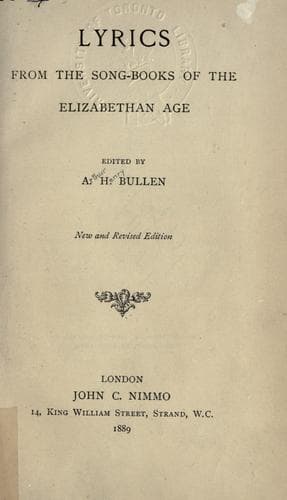
Lyrics from the Song-Books of the Elizabethan Age
General
Lyrics from the Song-Books of the Elizabethan Age
Ballads, English -- Texts; English poetry -- Early modern, 1500-1700; Songs, English -- England -- Texts
From THOMAS MORLEY's _Canzonets_, 1593.
Do you not know how Love lost first his seeing?
Because with me once gazing
On those fair eyes where all powers have their being,
She with her beauty blazing,
Which death might have revived,
Him of his sight and me of heart deprived.
From JOHN WILBYE's _Second Set of Madrigals_, 1609.
Draw on, sweet Night, best friend unto those cares
That do arise from painful melancholy;
My life so ill through want of comfort fares,
That unto thee I consecrate it wholly.
Sweet Night, draw on; my griefs, when they be told
To shades and darkness, find some ease from paining;
And while thou all in silence dost enfold,
I then shall have best time for my complaining.
From HENRY YOULL's _Canzonets to three Voices_, 1608.
Each day of thine, sweet month of May,
Love makes a solemn holyday:
I will perform like duty,
Since thou resemblest every way
Astraea, Queen of Beauty.
From THOMAS CAMPION's _Fourth Book of Airs_ (circ. 1613).
Every dame affects good fame, whate'er her doings be,
But true praise is Virtue's bays, which none may wear but she.
Borrowed guise fits not the wise, a simple look is best;
Native grace becomes a face though ne'er so rudely drest.
Now such new-found toys are sold these women to disguise,
That before the year grows old the newest fashion dies.
Dames of yore contended more in goodness to exceed,
Than in pride to be envied for that which least they need.
Little lawn then serve[d] the Pawn, if Pawn at all there were;
Homespun thread and household bread then held out all the year.
But th' attires of women now wear out both house and land;
That the wives in silk may flow, at ebb the good men stand.
Once again, Astraea! then from heaven to earth descend,
And vouchsafe in their behalf these errors to amend.
Aid from heaven must make all even, things are so out of frame;
For let man strive all he can, he needs must please his dame.
Happy man, content that gives and what he gives enjoys!
Happy dame, content that lives and breaks no sleep for toys!
From FARMER's _First Set of English Madrigals_, 1599.
Fair Phyllis I saw sitting all alone,
Feeding her flock near to the mountain-side;
The shepherds knew not whither she was gone,
But after her lover Amyntas hied.
Up and down he wandered, whilst she was missing;
When he found her, oh then they fell a-kissing!
From WILLIAM BYRD's _Psalms, Sonnets, and Songs_, 1588.
Farewell, false Love, the oracle of lies,
A mortal foe and enemy to rest,
An envious boy from whom all cares arise,
A bastard vile, a beast with rage possest;
A way of error, a temple full of treason,
In all effects contrary unto reason.
Public-domain text, read in full here on John Shaqi.
Reviews
Reviews
No reviews yet
Be the first to share your thoughts on this work.
Join the Discussion
Join the discussion
Sign in to leave a comment or review.
Sign InorCreate an account