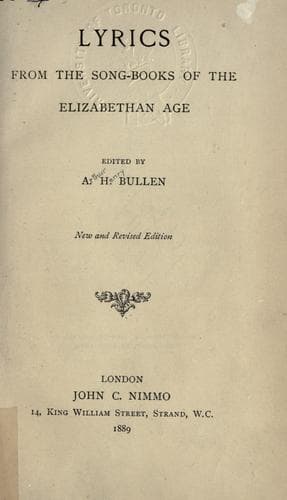
Ballads, English -- Texts; English poetry -- Early modern, 1500-1700; Songs, English -- England -- Texts
Heigh ho! chill go to plough no more!
Sit down and take thy rest;
Of golden groats I have full store
To flaunt it with the best.
But I love and I love, and who thinks you?
The finest lass that e'er you knew,
Which makes me sing when I should cry
Heigh ho! for love I die.
From JOHN MAYNARD's _Twelve Wonders of the World_, 1611.
THE BACHELOR.
How many things as yet
Are dear alike to me!
The field, the horse, the dog,
Love, arms, or liberty.
I have no wife as yet
That I may call mine own;
I have no children yet
That by my name are known.
Yet, if I married were,
I would not wish to thrive
If that I could not tame
The veriest shrew alive.
From THOMAS FORD's _Music of Sundry Kinds_, 1607.
How shall I then describe my Love?
When all men's skilful art
Is far inferior to her worth,
To praise the unworthiest part.
She's chaste in looks, mild in her speech,
In actions all discreet,
Of nature loving, pleasing most,
In virtue all complete.
And for her voice a Philomel,
Her lips may all lips scorn;
No sun more clear than is her eye,
In brightest summer morn.
A mind wherein all virtues rest
And take delight to be,
And where all virtues graft themselves
In that most fruitful tree:
A tree that India doth not yield,
Nor ever yet was seen,
Where buds of virtue always spring,
And all the year grow green.
That country's blest wherein she grows,
And happy is that rock
From whence she springs: but happiest he
That grafts in such a stock.
From HENRY LICHFILD's _First Set of Madrigals_, 1613.
I always loved to call my lady Rose,
For in her cheeks roses do sweetly glose,
And from her lips she such sweet odours threw
As roses do 'gainst Ph[oe]bus' morning-view:
But when I thought to pull't, hope was bereft me,--
My rose was gone and naught but prickles left me.
From _Melismata_, 1611.
A WOOING SONG OF A YEOMAN OF KENT'S SON.
I have house and land in Kent,
And if you'll love me, love me now;
Twopence-halfpenny is my rent,
I cannot come every day to woo.
Chorus. _Twopence-halfpenny is his rent,
And he cannot come every day to woo._
Ich am my vather's eldest zonne,
My mother eke doth love me well,
For ich can bravely clout my shoone,
And ich full well can ring a bell.
Chorus. _For he can bravely clout his shoone,
And he full well can ring a bell._
My vather he gave me a hog,
My mouther she gave me a zow;
I have a God-vather dwels thereby,
And he on me bestowed a plow.
Chorus. _He has a God-vather dwells thereby,
And he on him bestowed a plough._
Public-domain text, read in full here on John Shaqi.
Reviews
Reviews
No reviews yet
Be the first to share your thoughts on this work.
Join the Discussion
Join the discussion
Sign in to leave a comment or review.
Sign InorCreate an account