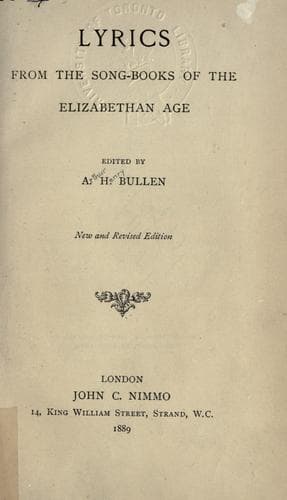
Ballads, English -- Texts; English poetry -- Early modern, 1500-1700; Songs, English -- England -- Texts
If love doth make men's lives too sour,
Let me not love, nor live henceforth!
Die shall my hopes, but not my faith,
That you, that of my fall may hearers be,
May hear Despair, which truly saith
"I was more true to Love, than Love to me."
From THOMAS CAMPION's _Third Book of Airs_ (circ. 1613).
If thou long'st so much to learn, sweet boy, what 'tis to love,
Do but fix thy thoughts on me and thou shalt quickly prove:
Little suit at first shall win
Way to thy abashed desire,
But then will I hedge thee in,
Salamander-like, with fire.
With thee dance I will, and sing, and thy fond dalliance bear;
We the grovy hills will climb and play the wantons there;
Other whiles we'll gather flowers,
Lying dallying on the grass;
And thus our delightful hours,
Full of waking dreams, shall pass.
When thy joys were thus at height, my love should turn from thee,
Old acquaintance then should grow as strange, as strange might be:
Twenty rivals thou shouldst find,
Breaking all their hearts for me,
While to all I'll prove more kind
And more forward than to thee.
Thus thy silly youth, enraged, would soon my love defy,
But, alas, poor soul, too late! clipt wings can never fly.
Those sweet hours which we had past,
Called to thy mind, thy heart would burn;
And couldst thou fly ne'er so fast,
They would make thee straight return.
From WILLIAM BYRD's _Psalms, Sonnets and Songs_, 1588.
If women could be fair and never fond,
Or that their beauty might continue still,
I would not marvel though they made men bond
By service long to purchase their goodwill:
But when I see how frail these creatures are,
I laugh that men forget themselves so far.
To mark what choice they make and how they change,
How, leaving best, the worst they choose out still;
And how, like haggards wild, about they range,
And scorning reason follow after will![6]
Who would not shake such buzzards from the fist
And let them fly (fair fools!) which way they list?
Yet for our sport we fawn and flatter both,
To pass the time when nothing else can please:
And train them on to yield by subtle oath
The sweet content that gives such humour ease:
And then we say, when we their follies try,
"To play with fools, O, what a fool was I!"
[6] So Oliphant.--Old ed., "Scorning after reason to follow will."
From WILLIAM BYRD's _Psalms, Songs, and Sonnets_, 1611.
In crystal towers and turrets richly set
With glitt'ring gems that shine against the sun,
In regal rooms of jasper and of jet,
Content of mind not always likes to won;[7]
But oftentimes it pleaseth her to stay
In simple cotes enclosed with walls of clay.
[7] Dwell.
Public-domain text, read in full here on John Shaqi.
Reviews
Reviews
No reviews yet
Be the first to share your thoughts on this work.
Join the Discussion
Join the discussion
Sign in to leave a comment or review.
Sign InorCreate an account