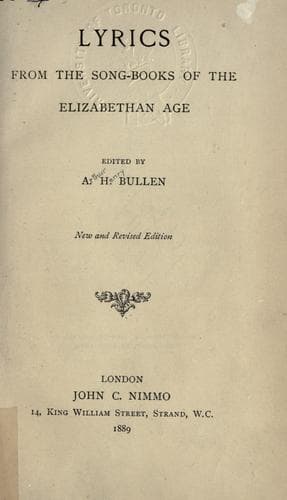
Ballads, English -- Texts; English poetry -- Early modern, 1500-1700; Songs, English -- England -- Texts
It was the frog in the well,
Humbledum, humbledum,
And the merry mouse in the mill,
Tweedle, tweedle, twino.
The frog would a wooing ride
Sword and buckler by his side.
When he upon his high horse set,
His boots they shone as black as jet.
When he came to the merry mill-pin,--
"Lady Mouse, been you within?"
Then came out the dusty mouse:
"I am Lady of this house:
Hast thou any mind of me?"
"I have e'en great mind of thee?"
"Who shall this marriage make?"
"Our Lord which is the rat,"
"What shall we have to our supper?"
"Three beans in a pound of butter?"
When supper they were at,
The frog, the mouse, and e'en the rat;
Then came in Gib our cat,
And catched the mouse e'en by the back.
Then did they separate,
And the frog leaped on the floor so flat.
Then came in Dick our drake,
And drew the frog e'en to the lake.
The rat run up the wall,
Humbledum, humbledum;
A goodly company, the Devil go with all!
Tweedle tweedle twino.
From THOMAS CAMPION's _Two Books of Airs_ (circ. 1613).
Jack and Joan, they think no ill,
But loving live, and merry still;
Do their week-days' work, and pray
Devoutly on the holy day:
Skip and trip it on the green,
And help to choose the Summer Queen;
Lash out at a country feast
Their silver penny with the best.
Well can they judge of nappy ale,
And tell at large a winter tale;
Climb up to the apple loft,
And turn the crabs till they be soft.
Tib is all the father's joy,
And little Tom the mother's boy.
All their pleasure is Content;
And Care, to pay their yearly rent.
Joan can call by name her cows
And deck her windows with green boughs;
She can wreaths and tutties[9] make,
And trim with plums a bridal cake.
Jack knows what brings gain or loss;
And his long flail can stoutly toss:
Makes the hedge which others break,
And ever thinks what he doth speak.
Now, you courtly dames and knights,
That study only strange delights;
Though you scorn the homespun gray
And revel in your rich array;
Though your tongues dissemble deep,
And can your heads from danger keep;
Yet, for all your pomp and train,
Securer lives the silly swain.
[9] Nosegays.
From THOMAS CAMPION's _Third Book of Airs_ (circ. 1613).
Kind are her answers,
But her performance keeps no day;
Breaks time, as dancers,
From their own music when they stray.
All her free favours and smooth words
Wing my hopes in vain.
O, did ever voice so sweet but only feign?
Can true love yield such delay,
Converting joy to pain?
Public-domain text, read in full here on John Shaqi.
Reviews
Reviews
No reviews yet
Be the first to share your thoughts on this work.
Join the Discussion
Join the discussion
Sign in to leave a comment or review.
Sign InorCreate an account