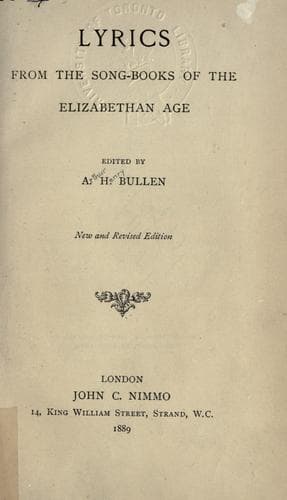
Ballads, English -- Texts; English poetry -- Early modern, 1500-1700; Songs, English -- England -- Texts
Th' ape loves to meddle
When he finds a man idle,
Else is he a-flirting
Where his mark is a-courting;
When women grow true
Come teach me to sue,
Then I'll come to thee
Pray thee and woo thee.
Little boy, pretty knave, make me not stagger,
For if you hit me, knave, I'll call thee, beggar.
From ROBERT JONES' _Second Book of Songs and Airs_, 1601.
Love winged my hopes and taught me how to fly
Far from base earth, but not to mount too high;
For true pleasure
Lives in measure,
Which if men forsake,
Blinded they into folly run and grief for pleasure take.
But my vain hopes, proud of their new-taught flight,
Enamoured sought to woo the sun's fair light,
Whose rich brightness
Moved their lightness
To aspire so high
That all scorched and consumed with fire now drown'd in woe they lie.
And none but Love their woeful hap did rue,
For Love did know that their desires were true;
Though Fate frowned,
And now drowned
They in sorrow dwell,
It was the purest light of heaven for whose fair love they fell.
From THOMAS CAMPION's _Third Book of Airs_ (circ. 1613).
"Maids are simple," some men say,
"They forsooth will trust no men."
But should they men's wills obey,
Maids were very simple then.
Truth a rare flower now is grown,
Few men wear it in their hearts;
Lovers are more easily known
By their follies than deserts.
Safer may we credit give
To a faithless wandering Jew,
Than a young man's vows believe
When he swears his love is true.
Love they make a poor blind child,
But let none trust such as he;
Rather than to be beguiled,
Ever let me simple be.
From _Melismata_, 1611.
THE BELLMAN's SONG.
Maids to bed and cover coal;
Let the mouse out of her hole;
Crickets in the chimney sing
Whilst the little bell doth ring;
If fast asleep, who can tell
When the clapper hits the bell?
From MARTIN PEERSON's _Mottects or Grave Chamber-Music_, 1630.
More than most fair, full of all heavenly fire,
Kindled above to shew the Maker's glory;
Beauty's first-born, in whom all powers conspire
To write the Graces' life and Muses' story;
If in my heart all nymphs else be defaced,
Honour the shrine where you alone are placed.
Thou window of the sky, and pride of spirits,
True character of honour in perfection,
Thou heavenly creature, judge of earthly merits,
And glorious prison of men's pure affection:
If in my heart all nymphs else be defaced
Honour the shrine where you alone are placed.
From THOMAS VAUTOR's _Songs of divers Airs and Natures_, 1619.
Mother, I will have a husband,
And I will have him out of hand!
Mother, I will sure have one
In spite of her that will have none.
Public-domain text, read in full here on John Shaqi.
Reviews
Reviews
No reviews yet
Be the first to share your thoughts on this work.
Join the Discussion
Join the discussion
Sign in to leave a comment or review.
Sign InorCreate an account