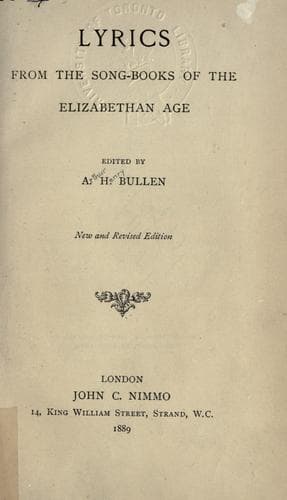
Ballads, English -- Texts; English poetry -- Early modern, 1500-1700; Songs, English -- England -- Texts
Thus I resolve and Time hath taught me so:
Since she is fair and ever kind to me,
Though she be wild and wanton-like in show,
Those little stains in youth I will not see.
That she be constant, heaven I oft implore;
If prayers prevail not, I can do no more.
Palm-tree the more you press, the more it grows;
Leave it alone, it will not much exceed:
Free beauty, if you strive to yoke, you lose,
And for affection strange distaste you breed.
What nature hath not taught no art can frame;
Wild-born be wild still, though by force you tame.
From JOHN WILBYE's _Madrigals_, 1598.
Thus saith my Chloris bright
When we of love sit down and talk together:--
"Beware of Love, dear; Love is a walking sprite,
And Love is this and that
And, O, I know not what,
And comes and goes again I wot not whether."[21]
No, no, these are but bugs to breed amazing,
For in her eyes I saw his torch-light blazing.
[21] Old form of "whither."
From THOMAS MORLEY's _First Book of Ballets to Five Voices_, 1595.
Thus saith my Galatea:
Love long hath been deluded,
When shall it be concluded?
The young nymphs all are wedded:
Ah, then why do I tarry?
Oh, let me die or marry.
From THOMAS CAMPION's _Fourth Book of Airs_ (circ. 1613).
To his sweet lute Apollo sang the motions of the spheres,
The wondrous orders of the stars whose course divides the years,
And all the mysteries above;
But none of this could Midas move:
Which purchased him his ass's ears.
Then Pan with his rude pipe began the country wealth t' advance,
To boast of cattle, flocks of sheep, and goats on hills that dance,
With much more of this churlish kind,
That quite transported Midas' mind,
And held him wrapt in trance.
This wrong the God of Music scorned from such a sottish judge,
And bent his angry bow at Pan, which made the piper trudge:
Then Midas' head he so did trim
That every age yet talks of him
And Ph[oe]bus' right revenged grudge.
From ROBERT DOWLAND's _Musical Banquet_, 1610. (The lines are assigned
to Robert Deveureux, Earl of Essex.)
To plead my faith, where faith hath no reward,
To move remorse where favour is not borne,
To heap complaints where she doth not regard,
Were fruitless, bootless, vain, and yield but scorn.
I loved her whom all the world admired,
I was refused of her that can love none,
And my vain hopes which far too high aspired
Is dead and buried and for ever gone.
Forget my name since you have scorned my love,
And woman-like do not too late lament:
Since for your sake I do all mischief prove,
I none accuse nor nothing do repent:
I was as fond as ever she was fair,
Yet loved I not more than I now despair.
From THOMAS WEELKES' _Ballets and Madrigals_, 1598.
Public-domain text, read in full here on John Shaqi.
Reviews
Reviews
No reviews yet
Be the first to share your thoughts on this work.
Elsewhere in the archive
Join the Discussion
Join the discussion
Sign in to leave a comment or review.
Sign InorCreate an account