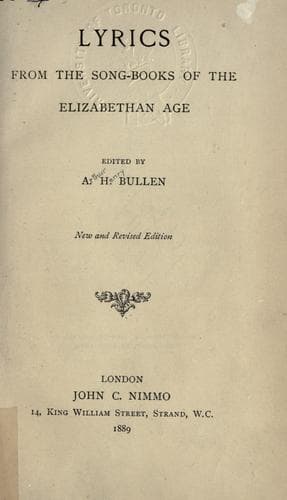
Ballads, English -- Texts; English poetry -- Early modern, 1500-1700; Songs, English -- England -- Texts
To shorten winter's sadness
See where the nymphs with gladness
Fa la la!
Disguised all are coming,
Right wantonly a-mumming.
Fa la la!
Though masks encloud their beauty,
Yet give the eye her duty.
Fa la la!
When Heaven is dark it shineth
And unto love inclineth.
Fa la la!
From JOHN DOWLAND's _Second Book of Songs and Airs_, 1600.
Toss not my soul, O Love, 'twixt hope and fear!
Show me some ground where I may firmly stand,
Or surely fall! I care not which appear,
So one will close me in a certain band.
When once of ill the uttermost is known;
The strength of sorrow quite is overthrown!
Take me, Assurance, to thy blissful hold!
Or thou Despair, unto thy darkest cell!
Each hath full rest: the one, in joys enroll'd;
Th' other, in that he fears no more, is well.
When once the uttermost of ill is known,
The strength of sorrow quite is overthrown.
From THOMAS CAMPION's _Fourth Book of Airs_ (circ. 1613).
Turn all thy thoughts to eyes,
Turn all thy hairs to ears,
Change all thy friends to spies
And all thy joys to fears;
True love will yet be free
In spite of jealousy.
Turn darkness into day,
Conjectures into truth,
Believe what th' envious say,
Let age interpret youth:
True love will yet be free
In spite of jealousy.
Wrest every word and look,
Rack every hidden thought;
Or fish with golden hook,
True love cannot be caught:
For that will still be free
In spite of jealousy.
From THOMAS FORD's _Music of Sundry Kinds_, 1607.
Unto the temple of thy beauty,
And to the tomb where pity lies,
I, pilgrim-clad with zeal and duty,
Do offer up my heart, mine eyes.
My heart, lo! in the quenchless fire,
On love's burning altar lies,
Conducted thither by desire
To be beauty's sacrifice.
But pity on thy sable hearse,
Mine eyes the tears of sorrow shed;
What though tears cannot fate reverse,
Yet are they duties to the dead.
O, Mistress, in thy sanctuary
Why wouldst thou suffer cold disdain
To use his frozen cruelty,
And gentle pity to be slain?
Pity that to thy beauty fled,
And with thy beauty should have lived,
Ah, in thy heart lies buried,
And nevermore may be revived;
Yet this last favour, dear, extend,
To accept these vows, these tears I shed,
Duties which I thy pilgrim send,
To beauty living, pity dead.
From THOMAS WEELKES' _Airs or Fantastic Spirits_, 1608.
Upon a hill the bonny boy
Sweet Thyrsis sweetly played,
And called his lambs their master's joy,
And more he would have said;
But love that gives the lover wings
Withdrew his mind from other things.
Public-domain text, read in full here on John Shaqi.
Reviews
Reviews
No reviews yet
Be the first to share your thoughts on this work.
Elsewhere in the archive
Join the Discussion
Join the discussion
Sign in to leave a comment or review.
Sign InorCreate an account