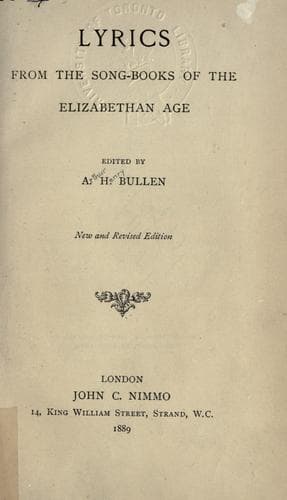
Ballads, English -- Texts; English poetry -- Early modern, 1500-1700; Songs, English -- England -- Texts
But such as will run mad with Will,
I cannot clear their sight
But leave them to their study still,
To look where is no light!
Till time too late, we make them try,
They study false Astronomy!
From THOMAS FORD's _Music of Sundry Kinds_, 1607.
What then is love, sings Corydon,
Since Phyllida is grown so coy?
A flattering glass to gaze upon,
A busy jest, a serious toy,
A flower still budding, never blown,
A scanty dearth in fullest store
Yielding least fruit where most is sown.
My daily note shall be therefore--
Heigh ho, chil love no more.
'Tis like a morning dewy rose
Spread fairly to the sun's arise,
But when his beams he doth disclose
That which then flourish'd quickly dies;
It is a seld-fed dying hope,
A promised bliss, a salveless sore,
An aimless mark, and erring scope.
My daily note shall be therefore,--
Heigh ho, chil love no more.
'Tis like a lamp shining to all,
Whilst in itself it doth decay;
It seems to free whom it doth thrall,
And lead our pathless thoughts astray.
It is the spring of wintered hearts
Parched by the summer's heat before
Faint hope to kindly warmth converts.
My daily note shall be therefore--
Heigh ho, chil love no more.
From RICHARD CARLTON's _Madrigals_, 1601.
When Flora fair the pleasant tidings bringeth
Of summer sweet with herbs and flowers adorned,
The nightingale upon the hawthorn singeth
And Boreas' blasts the birds and beasts have scorned;
When fresh Aurora with her colours painted,
Mingled with spears of gold, the sun appearing,
Delights the hearts that are with love acquainted,
And maying maids have then their time of cheering;
All creatures then with summer are delighted,
The beasts, the birds, the fish with scale of silver;
Then stately dames by lovers are invited
To walk in meads or row upon the river.
I all alone am from these joys exiled,
No summer grows where love yet never smiled.
From WILLIAM BYRD's _Songs of Sundry Natures_, 1589.
When I was otherwise than now I am,
I loved more but skilled not so much
Fair words and smiles could have contented then,
My simple age and ignorance was such:
But at the length experience made me wonder
That hearts and tongues did lodge so far asunder.
As watermen which on the Thames do row,
Look to the east but west keeps on the way;
My sovereign sweet her count'nance settled so,
To feed my hope while she her snares might lay:
And when she saw that I was in her danger,
Good God, how soon she proved then a ranger!
Public-domain text, read in full here on John Shaqi.
Reviews
Reviews
No reviews yet
Be the first to share your thoughts on this work.
Elsewhere in the archive
Join the Discussion
Join the discussion
Sign in to leave a comment or review.
Sign InorCreate an account