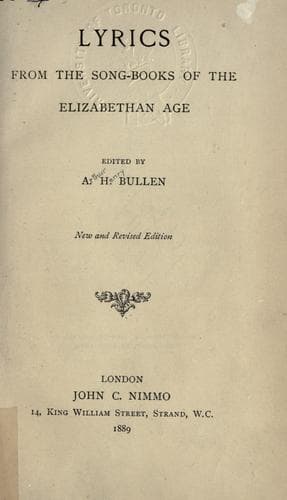
Ballads, English -- Texts; English poetry -- Early modern, 1500-1700; Songs, English -- England -- Texts
I could not choose but laugh, although too late,
To see great craft decypher'd in a toy;
I love her still, but such conditions hate
Which so profanes my paradise of joy.
Love whets the wits, whose pain is but a pleasure;
A toy, by fits to play withal at leisure.
From CAMPION and ROSSETER's _Book of Airs_, 1601.
When thou must home to shades of underground,
And there arrived, a new admired guest,
The beauteous spirits do engirt thee round,
White Iope, blithe Helen, and the rest,
To hear the stories of thy finished love
From that smooth tongue whose music hell can move;
Then wilt thou speak of banqueting delights,
Of masques and revels which sweet youth did make,
Of tourneys and great challenges of Knights,
And all these triumphs for thy beauty sake:
When thou hast told these honours done to thee,
Then tell, O tell, how thou didst murder me.
From WILLIAM BYRD's _Songs of Sundry Natures_, 1589.
{deinos Eros, deinos; ti de to pleon, en palin eipo,
kai palin, oimozon pollaki, deinos Eros?}
MELEAG.
When younglings first on Cupid fix their sight,
And see him naked, blindfold, and a boy,
Though bow and shafts and firebrand be his might,
Yet ween they he can work them none annoy;
And therefore with his purple wings they play,
For glorious seemeth love though light as feather,
And when they have done they ween to scape away,
For blind men, say they, shoot they know not whither.
But when by proof they find that he did see,
And that his wound did rather dim their sight,
They wonder more how such a lad as he
Should be of such surpassing power and might.
But ants have galls, so hath the bee his sting:
Then shield me, heavens, from such a subtle thing!
From JOHN WILBYE's _Second Set of Madrigals_, 1609.
Where most my thoughts, there least mine eye is striking;
Where least I come there most my heart abideth;
Where most I love I never show my liking;
From what my mind doth hold my body slideth;
I show least care where most my care dependeth;
A coy regard where most my soul attendeth.
Despiteful thus unto myself I languish,
And in disdain myself from joy I banish.
These secret thoughts enwrap me so in anguish
That life, I hope, will soon from body vanish,
And to some rest will quickly be conveyed
That on no joy, while so I lived, hath stayed.
From MARTIN PEARSON's _Mottects or Grave Chamber-Music_, 1630.
A MOURNING-SONG FOR THE DEATH OF SIR FULKE GREVILLE, LORD BROOKE.
Public-domain text, read in full here on John Shaqi.
Reviews
Reviews
No reviews yet
Be the first to share your thoughts on this work.
Elsewhere in the archive
Join the Discussion
Join the discussion
Sign in to leave a comment or review.
Sign InorCreate an account