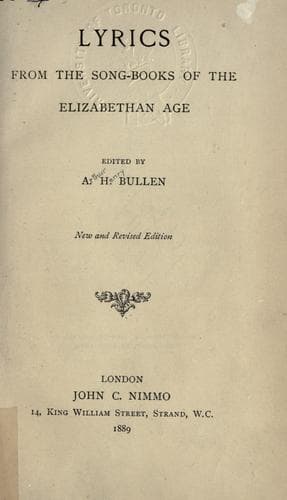
Ballads, English -- Texts; English poetry -- Early modern, 1500-1700; Songs, English -- England -- Texts
Though strange outlandish spirits
Praise towns and countries scorn,
The country is my home,
I dwell where I was born.
There profit and command
With pleasure I partake,
Yet do not hawks and dogs
My sole companions make.
I rule, but not oppress;
End quarrels, not maintain;
See towns, but dwell not there
To abridge my charge or train.
THE WIFE.
The first of all our sex
Came from the side of man,
I thither am return'd
From whence our sex began.
I do not visit oft,
Nor many when I do,
I tell my mind to few
And that in counsel too.
I seem not sick in health,
Nor sullen but in sorrow;
I care for somewhat else
Than what to wear to-morrow.
THE WIDOW.
My dying husband knew
How much his death would grieve me,
And therefore left me wealth
To comfort and relieve me.
Though I no more will have,
I must not love disdain;
Penelope her self
Did suitors entertain.
And yet to draw on such
As are of best esteem,
Nor younger than I am
Nor richer will I seem."
_Page_ 41. "I have house and land in Kent."--This admirable song has
been frequently reprinted. Miss De Vaynes, in her very valuable "Kentish
Garland" (i., 142), observes:--"We have met with no other song in the
Kentish dialect except Jan Ploughshare's" (printed on p. 372, vol. i.,
of the "Garland"). Rimbault in his "Little Book of Songs and Ballads"
(1851), gives the following lines from an old MS. (temp. Henry VIII.):--
"Joan, quoth John, when will this be?
Tell me when wilt thou marry me,
My corn and eke my calf and rents,
My lands and all my tenements?
Say, Joan, quoth John, what wilt thou do?
I cannot come every day to woo?"
David Herd printed a fragment of a Scotch song that was founded on the
English song:--
"I hae layen three herring a' sa't,
Bonny lass, gin ze'll take me, tell me now,
And I hae brew'n three pickles o' ma't
And I cannae cum ilka day to woo.
_To woo, to woo, to lilt and to woo,
And I cannae cum ilka day to woo_.
I hae a wee ca'f that wad fain be a cow,
Bonny lassie, gin ye'll take me, tell me now,
I hae a wee gryce that wad fain be a sow,
And I cannae cum ilka day to woo.
_To woo, to woo, to lilt and to woo,
And I cannae cum ilka day to woo_."
_Page_ 43. "I joy not in no earthly bliss."--These stanzas are usually
printed with "My mind to me a kingdom is" (p. 78), and the whole poem
has been attributed to Sir Edward Dyer.
_Page_ 47. "I weigh not Fortune's frown nor smile."--These lines (which
seem to have been modelled on "I joy not in no earthly bliss") are by
Joshua Sylvester.
In the second stanza, "I sound not at the news of wreck," _sound_ is an
old form of _swoon_.
_Page_ 52. "If women could be fair."--This poem is ascribed to Edward,
Earl of Oxford, in Rawlinson, MS. 85, fol. 16.
Public-domain text, read in full here on John Shaqi.
Reviews
Reviews
No reviews yet
Be the first to share your thoughts on this work.
Elsewhere in the archive
Join the Discussion
Join the discussion
Sign in to leave a comment or review.
Sign InorCreate an account