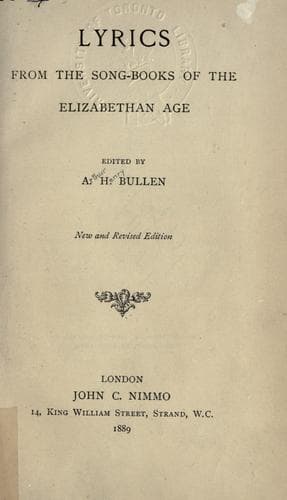
Ballads, English -- Texts; English poetry -- Early modern, 1500-1700; Songs, English -- England -- Texts
_Page_ 68. "Then all at once _for our town_ cries."--"I should imagine,"
says Oliphant, "that there was occasionally a sort of friendly
contention in the sports between neighbouring villages; which idea is
rather corroborated by a passage from an old play called the
'Vow-breaker' by Samson, 1636: 'Let the major play the hobby-horse an'
he will; I hope _our Town lads_ cannot want a hobby-horse.'" In an old
play. "The Country Girl," (first printed in 1647), attributed to that
shadowy personage Antony Brewer, we have an allusion to this pleasant
form of rivalry:--
"_Abraham._ Sister Gillian,--I have the rarest news for you.
_Gillian._ For me? 'tis well. And what news have you got, sir?
_Abr._ Skipping news, lipping news, tripping news.
_Gil._ How! dancing, brother Abram, dancing?
_Abr._ Prancing, advancing, dancing. Nay, 'tis a match, a
match upon a wager.
_Gil._ A match. Who be they?
_Abr._ Why all the wenches of _our town_ Edmonton, and all the
mad wenches of Waltham.
_Gil._ A match, and leave me out! When, when is't, brother?
_Abr._ Marry, e'en this morning:--they are now going to't
helter-skelter. [_A treble plays within_.
_Gil._ And leave me out! where, brother, where?
_Abr._ Why there, Sister Gillian; there, at our own door almost,--on
the green there, close by the may-pole. Hark! you may hear them
hither." (Sig. D.)
The stage-direction at the entrance of the dancers runs thus:--"Enter
six country wenches, all red petticoats, white stitch'd bodies, in their
smock-sleeves, the fiddler before them, and Gillian with her tippet up
in the midst of them dancing."
_Page_ 73. "It was the purest light of heaven" &c.--I am reminded of a
fine passage in Drayton's "Barons' Wars," canto VI.:--
"Looking upon proud Phaeton wrapped in fire,
The gentle queen did much bewail his fall;
But Mortimer commended his desire
To lose one poor life or to govern all.
'What though,' quoth he, 'he madly did aspire
And his great mind made him proud Fortune's thrall?
Yet, in despight when she her worst had done,
_He perish'd in the chariot of the sun_.'"
_Page_ 74. "The Bellman's Song."--In "Robin Goodfellow; his mad pranks
and merry jests," 1628, we have another specimen of a Bellman's Song:--
"Sometimes would he go like a bellman in the night, and with many pretty
verses delight the ears of those that waked at his bell-ringing: his
verses were these:--
Maids in your smocks,
Look well to your locks,
And your tinder-box,
Your wheels and your rocks,
Your hens and your cocks,
Your cows and your ox,
And beware of the fox.
When the bellman knocks
Put out your fire and candle-light,
So they shall not you affright.
May you dream of your delights,
In your sleeps see pleasing sights!
Good rest to all, both old and young:
The bellman now hath done his song.
Then would he go laughing _Ho ho ho!_ as his use was."
Public-domain text, read in full here on John Shaqi.
Reviews
Reviews
No reviews yet
Be the first to share your thoughts on this work.
Elsewhere in the archive
Join the Discussion
Join the discussion
Sign in to leave a comment or review.
Sign InorCreate an account