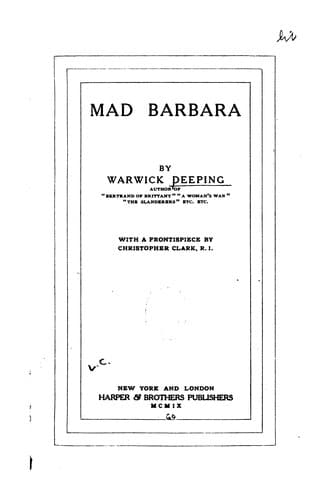
Great Britain -- History -- Charles II, 1660-1685 -- Fiction
Sparkin did not betray any self-conscious cowardice.
“He was worse off, captain.”
“Poor devil!” And the man in the red coat laughed.
They turned into “The Three Tuns” at Charing Cross, the sea-captain
looking more like a Whitefriars’ bully than a gentleman adventurer. Two
comfortable citizens gathered up the skirts of their coats and edged
away sourly when the new-comers sat down next them at a table. The
captain remarked their neighborly caution, and smiled.
“Good-day, gentlemen. We embarrass you, perhaps?”
There was a humorous grimness about his mouth that carried conviction.
“Not at all, sir, not at all,” said the larger of the twain, poised
between propitiation and distrust.
“We are not Scotch, sir, so you will catch nothing.”
They dined in silence, the boy’s animation divided between his plate and
his surroundings, while the man in the red coat watched him with the air
of one who has an abundant past to feed his thoughts. His neighbors cast
curious momentary glances at him from time to time, but having once
spoken he appeared to have forgotten their existence. They had but to
look beneath the superficial shabbiness to see that the man was of some
standing in the world. He had that gift of remaining statuesquely
silent, that poise that suggests power. The brown, resolute face had the
comeliness of courage. Of no great stature, his sturdy, hollow-backed
figure betrayed strength to those who could distinguish between fat and
muscle.
The boy’s appetite reached impotence at last. The man in the red coat
beckoned to the servant, paid his due with odd small change routed out
of every pocket, and with a curt bow to his neighbors walked out into
the street.
He made his way toward St. James’s, and paused in the street of that
same name, before a big house with a pompous portico. A flight of steps
led up to the great door.
“Run up—and knock.”
The boy obeyed, his breeches bringing a smile to the sea-captain’s face
as he waited unconcernedly on the sidewalk.
“Don’t mind your knuckles, my lad.”
And Sparkin hammered as though he were sounding the ship’s bell.
A servant in livery opened the door and looked down at the boy with the
air of a bully scenting a beggar. The man in the red coat listened to
the following dialogue:
“My Lord Gore’s house, this?”
“What d’you want at the front door?”
“Lord Gore’s house?”
“Oh—is it?”
“Well, is it, stupid?”
“Here, you skip it, you—”
The sea-captain interposed with a laugh curving his mouth. There was so
much significance in the fellow’s gospel of cloth.
“Wake up, Tom Richards!”
The footman’s eyes protruded. He stared down at the seaman with the air
of a superior being resenting and distrusting familiarity.
“Well, what d’you want?” And his glance added, “You shabby,
cutthroat-looking devil!”
Public-domain text, read in full here on John Shaqi.
Reviews
Reviews
No reviews yet
Be the first to share your thoughts on this work.
Join the Discussion
Join the discussion
Sign in to leave a comment or review.
Sign InorCreate an account