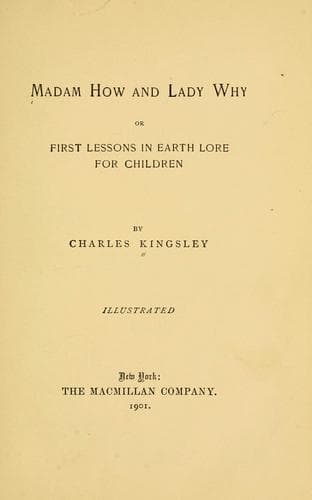
Madam How and Lady Why; Or, First Lessons in Earth Lore for ChildrenKingsley, Charles
History
Madam How and Lady Why; Or, First Lessons in Earth Lore for Children
Kingsley, Charles
Geology -- Juvenile literature; Natural history -- Juvenile literature
Of course. Making a man of you, out of a boy. And that can only be done
by the life-blood which runs through and through you. And the more you
laugh and shout, the more pure air will pass into your blood, and make it
red and healthy; and the more you romp and play--unless you overtire
yourself--the quicker will that blood flow through all your limbs, to
make bone and muscle, and help you to grow into a man.
But why does Lady Why like to see us play?
She likes to see you happy, as she likes to see the trees and birds
happy. For she knows well that there is no food, nor medicine either,
like happiness. If people are not happy enough, they are often tempted
to do many wrong deeds, and to think many wrong thoughts: and if by God's
grace they know the laws of Lady Why, and keep from sin, still
unhappiness, if it goes on too long, wears them out, body and mind; and
they grow ill and die, of broken hearts, and broken brains, my child; and
so at last, poor souls, find "Rest beneath the Cross."
Children, too, who are unhappy; children who are bullied, and frightened,
and kept dull and silent, never thrive. Their bodies do not thrive; for
they grow up weak. Their minds do not thrive; for they grow up dull.
Their souls do not thrive; for they learn mean, sly, slavish ways, which
God forbid you should ever learn. Well said the wise man, "The human
plant, like the vegetables, can only flower in sunshine."
So do you go, and enjoy yourself in the sunshine; but remember this--You
know what happiness is. Then if you wish to please Lady Why, and Lady
Why's Lord and King likewise, you will never pass a little child without
trying to make it happier, even by a passing smile. And now be off, and
play in the hay, and come back to me when you are tired.
* * * * *
Let us lie down at the foot of this old oak, and see what we can see.
And hear what we can hear, too. What is that humming all round us, now
that the noisy mowing-machine has stopped?
And as much softer than the noise of mowing-machine hum, as the machines
which make it are more delicate and more curious. Madam How is a very
skilful workwoman, and has eyes which see deeper and clearer than all
microscopes; as you would find, if you tried to see what makes that
"Midsummer hum" of which the haymakers are so fond, because it promises
fair weather.
Why, it is only the gnats and flies.
Only the gnats and flies? You might study those gnats and flies for your
whole life without finding out all--or more than a very little--about
them. I wish I knew how they move those tiny wings of theirs--a thousand
times in a second, I dare say, some of them. I wish I knew how far they
know that they are happy--for happy they must be, whether they know it or
not. I wish I knew how they live at all. I wish I even knew how many
sorts there are humming round us at this moment.
How many kinds? Three or four?
More probably thirty or forty round this single tree.
Public-domain text, read in full here on John Shaqi.
Reviews
Reviews
No reviews yet
Be the first to share your thoughts on this work.
Elsewhere in the archive
Join the Discussion
Join the discussion
Sign in to leave a comment or review.
Sign InorCreate an account