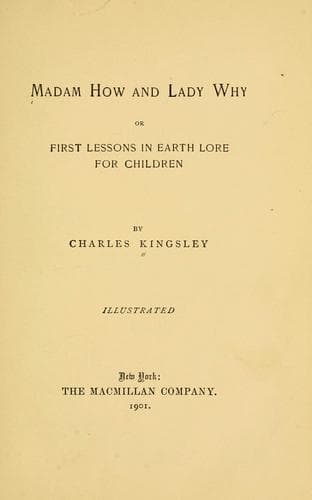
Madam How and Lady Why; Or, First Lessons in Earth Lore for ChildrenKingsley, Charles
History
Madam How and Lady Why; Or, First Lessons in Earth Lore for Children
Kingsley, Charles
Geology -- Juvenile literature; Natural history -- Juvenile literature
But why should there be so many kinds of living things? Would not one or
two have done just as well?
Why, indeed? Why should there not have been only one sort of butterfly,
and he only of one colour, a plain brown, or a plain white?
And why should there be so many sorts of birds, all robbing the garden at
once? Thrushes, and blackbirds, and sparrows, and chaffinches, and
greenfinches, and bullfinches, and tomtits.
And there are four kinds of tomtits round here, remember: but we may go
on with such talk for ever. Wiser men than we have asked the same
question: but Lady Why will not answer them yet. However, there is
another question, which Madam How seems inclined to answer just now,
which is almost as deep and mysterious.
What?
_How_ all these different kinds of things became different.
Oh, do tell me!
Not I. You must begin at the beginning, before you can end at the end,
or even make one step towards the end.
What do you mean?
You must learn the differences between things, before you can find out
how those differences came about. You must learn Madam How's alphabet
before you can read her book. And Madam How's alphabet of animals and
plants is, Species, Kinds of things. You must see which are like, and
which unlike; what they are like in, and what they are unlike in. You
are beginning to do that with your collection of butterflies. You like
to arrange them, and those that are most like nearest to each other, and
to compare them. You must do that with thousands of different kinds of
things before you can read one page of Madam How's Natural History Book
rightly.
But it will take so much time and so much trouble.
God grant that you may not spend more time on worse matters, and take
more trouble over things which will profit you far less. But so it must
be, willy-nilly. You must learn the alphabet if you mean to read. And
you must learn the value of the figures before you can do a sum. Why,
what would you think of any one who sat down to play at cards--for money
too (which I hope and trust you never will do)--before he knew the names
of the cards, and which counted highest, and took the other?
Of course he would be very foolish.
Just as foolish are those who make up "theories" (as they call them)
about this world, and how it was made, before they have found out what
the world is made of. You might as well try to find out how this hay-
field was made, without finding out first what the hay is made of.
How the hay-field was made? Was it not always a hay-field?
Ah, yes; the old story, my child: Was not the earth always just what it
is now? Let us see for ourselves whether this was always a hay-field.
How?
Just pick out all the different kinds of plants and flowers you can find
round us here. How many do you think there are?
Oh--there seem to be four or five.
Just as there were three or four kinds of flies in the air. Pick them,
child, and count. Let us have facts.
How many? What! a dozen already?
Public-domain text, read in full here on John Shaqi.
Reviews
Reviews
No reviews yet
Be the first to share your thoughts on this work.
Elsewhere in the archive
Join the Discussion
Join the discussion
Sign in to leave a comment or review.
Sign InorCreate an account