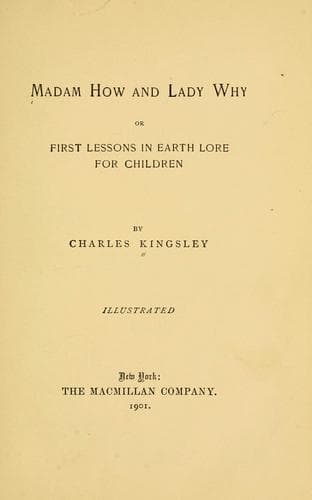
Madam How and Lady Why; Or, First Lessons in Earth Lore for ChildrenKingsley, Charles
History
Madam How and Lady Why; Or, First Lessons in Earth Lore for Children
Kingsley, Charles
Geology -- Juvenile literature; Natural history -- Juvenile literature
You will be miserable if you do not learn to understand little things:
because then you will not be able to understand great things when you
meet them. Children who are not trained to use their eyes and their
common sense grow up the more miserable the cleverer they are.
Why?
Because they grow up what men call dreamers, and bigots, and fanatics,
causing misery to themselves and to all who deal with them. So I say
again, think.
Well, I suppose men must have altered the soil inside the bank.
Well done. But why do you think so?
Because, of course, some one made the bank; and the brown soil only goes
up to it.
Well, that is something like common sense. Now you will not say any
more, as the cows or the butterflies might, that the hay-field was always
there.
And how did men change the soil?
By tilling it with the plough, to sweeten it, and manuring it, to make it
rich.
And then did all these beautiful grasses grow up of themselves?
You ought to know that they most likely did not. You know the new
enclosures?
Yes.
Well then, do rich grasses come up on them, now that they are broken up?
Oh no, nothing but groundsel, and a few weeds.
Just what, I dare say, came up here at first. But this land was tilled
for corn, for hundreds of years, I believe. And just about one hundred
years ago it was laid down in grass; that is, sown with grass seeds.
And where did men get the grass seeds from?
Ah, that is a long story; and one that shows our forefathers (though they
knew nothing about railroads or electricity) were not such simpletons as
some folks think. The way it must have been done was this. Men watched
the natural pastures where cattle get fat on the wild grass, as they do
in the Fens, and many other parts of England. And then they saved the
seeds of those fattening wild grasses, and sowed them in fresh spots.
Often they made mistakes. They were careless, and got weeds among the
seed--like the buttercups, which do so much harm to this pasture. Or
they sowed on soil which would not suit the seed, and it died. But at
last, after many failures, they have grown so careful and so clever, that
you may send to certain shops, saying what sort of soil yours is, and
they will send you just the seeds which will grow there, and no other;
and then you have a good pasture for as long as you choose to keep it
good.
And how is it kept good?
Look at all those loads of hay, which are being carried off the field. Do
you think you can take all that away without putting anything in its
place?
Why not?
If I took all the butter out of the churn, what must I do if I want more
butter still?
Put more cream in.
So, if I want more grass to grow, I must put on the soil more of what
grass is made of.
But the butter don't grow, and the grass does.
What does the grass grow in?
The soil.
Public-domain text, read in full here on John Shaqi.
Reviews
Reviews
No reviews yet
Be the first to share your thoughts on this work.
Elsewhere in the archive
Join the Discussion
Join the discussion
Sign in to leave a comment or review.
Sign InorCreate an account