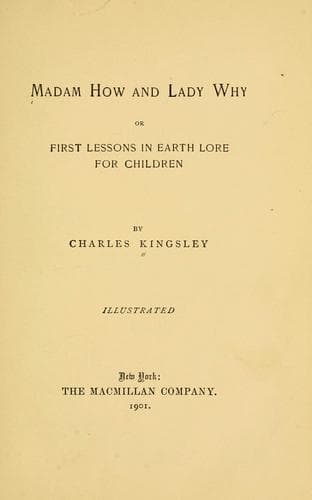
Madam How and Lady Why; Or, First Lessons in Earth Lore for ChildrenKingsley, Charles
History
Madam How and Lady Why; Or, First Lessons in Earth Lore for Children
Kingsley, Charles
Geology -- Juvenile literature; Natural history -- Juvenile literature
My dear child, the most wonderful part of Madam How's work is, that she
does such great things and so many different things, with one and the
same tool, which looks to you so simple, though it really is not so.
Water, for instance, is not a simple thing, but most complicated; and we
might spend hours in talking about water, without having come to the end
of its wonders. Still Madam How is a great economist, and never wastes
her materials. She is like the sailor who boasted (only she never
boasts) that, if he had but a long life and a strong knife, he would
build St. Paul's Cathedral before he was done. And Madam How has a very
long life, and plenty of time; and one of the strongest of all her tools
is water. Now if you will stoop down and look into the heather, I will
show you how she is digging out the glen with this very mist which is
hanging about our feet. At least, so I guess.
For see how the mist clings to the points of the heather leaves, and
makes drops. If the hot sun came out the drops would dry, and they would
vanish into the air in light warm steam. But now that it is dark and
cold they drip, or run down the heather-stems, to the ground. And
whither do they go then? Whither will the water go,--hundreds of gallons
of it perhaps,--which has dripped and run through the heather in this
single day? It will sink into the ground, you know. And then what will
become of it? Madam How will use it as an underground spade, just as she
uses the rain (at least, when it rains too hard, and therefore the rain
runs off the moor instead of sinking into it) as a spade above ground.
Now come to the edge of the glen, and I will show you the mist that fell
yesterday, perhaps, coming out of the ground again, and hard at work.
You know of what an odd, and indeed of what a pretty form all these glens
are. How the flat moor ends suddenly in a steep rounded bank, almost
like the crest of a wave--ready like a wave-crest to fall over, and as
you know, falling over sometimes, bit by bit, where the soil is bare.
Oh, yes; you are very fond of those banks. It is "awfully jolly," as you
say, scrambling up and down them, in the deep heath and fern; besides,
there are plenty of rabbit-holes there, because they are all sand; while
there are no rabbit-holes on the flat above, because it is all gravel.
Yes; you know all about it: but you know, too, that you must not go too
far down these banks, much less roll down them, because there is almost
certain to be a bog at the bottom, lying upon a gentle slope; and there
you get wet through.
Public-domain text, read in full here on John Shaqi.
Reviews
Reviews
No reviews yet
Be the first to share your thoughts on this work.
Join the Discussion
Join the discussion
Sign in to leave a comment or review.
Sign InorCreate an account