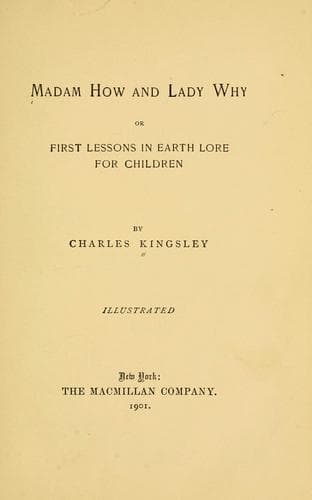
Madam How and Lady Why; Or, First Lessons in Earth Lore for ChildrenKingsley, Charles
History
Madam How and Lady Why; Or, First Lessons in Earth Lore for Children
Kingsley, Charles
Geology -- Juvenile literature; Natural history -- Juvenile literature
Again. There is a little pink butterwort here in the bogs, which grows,
too, in dear old Devonshire and Cornwall; and also in the south-west of
Scotland. Now, when I found that too, in the bogs near Biarritz, close
to the Pyrenees, and knew that it stretched away along the Spanish coast,
and into Portugal, what could my common sense lead me to say but that
Scotland, and Ireland, and Cornwall, and Spain were all joined once?
Those are only a few examples. I could give you a dozen more. For
instance, on an island away there to the west, and only in one spot,
there grows a little sort of lily, which is found I believe in Brittany,
and on the Spanish and Portuguese heaths, and even in North-west Africa.
And that Africa and Spain were joined not so very long ago at the Straits
of Gibraltar there is no doubt at all.
But where did the Mediterranean Sea run out then?
Perhaps it did not run out at all; but was a salt-water lake, like the
Caspian, or the Dead Sea. Perhaps it ran out over what is now the
Sahara, the great desert of sand, for, that was a sea-bottom not long
ago.
But then, how was this land of Atlantis joined to the Cape of Good Hope?
I cannot say how, or when either. But this is plain: the place in the
world where the most beautiful heaths grow is the Cape of Good Hope? You
know I showed you Cape heaths once at the nursery gardener's at home.
Oh yes, pink, and yellow, and white; so much larger than ours.
Then it seems (I only say it seems) as if there must have been some land
once to the westward, from which the different sorts of heath spread
south-eastward to the Cape, and north-eastward into Europe. And that
they came north-eastward into Europe seems certain; for there are no
heaths in America or Asia.
But how north-eastward?
Think. Stand with your face to the south and think. If a thing comes
from the south-west--from there, it must go to the north-east-towards
there. Must it not?
Oh yes, I see.
Now then--The farther you go south-west, towards Spain, the more kinds of
heath there are, and the handsomer; as if their original home, from which
they started, was somewhere down there.
More sorts! What sorts?
How many sorts of heath have we at home?
Three, of course: ling, and purple heath, and bottle heath.
And there are no more in all England, or Wales, or Scotland, except--Now,
listen. In the very farthest end of Cornwall there are two more sorts,
the Cornish heath and the Orange-bell; and they say (though I never saw
it) that the Orange-bell grows near Bournemouth.
Well. That is south and west too.
So it is: but that makes five heaths. Now in the south and west of
Ireland all these five heaths grow, and two more: the great Irish heath,
with purple bells, and the Mediterranean heath, which flowers in spring.
Oh, I know them. They grow in the Rhododendron beds at home.
Public-domain text, read in full here on John Shaqi.
Reviews
Reviews
No reviews yet
Be the first to share your thoughts on this work.
Elsewhere in the archive
Join the Discussion
Join the discussion
Sign in to leave a comment or review.
Sign InorCreate an account