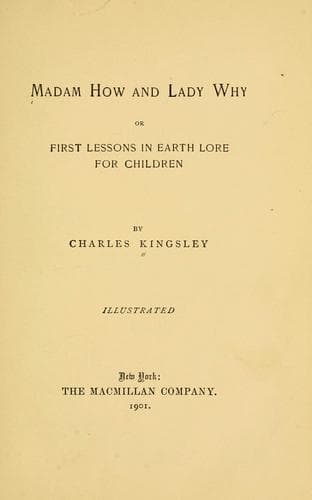
Madam How and Lady Why; Or, First Lessons in Earth Lore for ChildrenKingsley, Charles
History
Madam How and Lady Why; Or, First Lessons in Earth Lore for Children
Kingsley, Charles
Geology -- Juvenile literature; Natural history -- Juvenile literature
I know: but years ago it got the name from one green vein in it, in which
the "Coprolites," as you learnt to call them at Cambridge, are found; and
that, and a little layer of blue clay, called gault, between the upper
Greensand and lower Greensand, runs along everywhere at the foot of the
chalk hills.
I see the hills now. Are they chalk?
Yes, chalk they are: so we may begin to feel near home now. See how they
range away to the south toward Devizes, and Westbury, and Warminster, a
goodly land and large. At their feet, everywhere, run the rich pastures
on which the Wiltshire cheese is made; and here and there, as at
Westbury, there is good iron-ore in the greensand, which is being smelted
now, as it used to be in the Weald of Surrey and Kent ages since. I must
tell you about that some other time.
But are there Coprolites here?
I believe there are: I know there are some at Swindon; and I do not see
why they should not be found, here and there, all the way along the foot
of the downs, from here to Cambridge.
But do these downs go to Cambridge?
Of course they do. We are now in the great valley which runs right
across England from south-west to north-east, from Axminster in
Devonshire to Hunstanton in Norfolk, with the chalk always on your right
hand, and the oolite hills on your left, till it ends by sinking into the
sea, among the fens of Lincolnshire and Norfolk.
But what made that great valley?
I am not learned enough to tell. Only this I think we can say--that once
on a time these chalk downs on our right reached high over our heads
here, and far to the north; and that Madam How pared them away, whether
by icebergs, or by sea-waves, or merely by rain, I cannot tell.
Well, those downs do look very like sea-cliffs.
So they do, very like an old shore-line. Be that as it may, after the
chalk was eaten away, Madam How began digging into the soils below the
chalk, on which we are now; and because they were mostly soft clays, she
cut them out very easily, till she came down, or nearly down, to the
harder freestone rocks which run along on our left hand, miles away; and
so she scooped out this great vale, which we call here the Vale of White
Horse; and further on, the Vale of Aylesbury; and then the Bedford Level;
and then the dear ugly old Fens.
Is this the Vale of White Horse? Oh, I know about it; I have read _The
Scouring of the White Horse_.
Of course you have; and when you are older you will read a jollier book
still,--_Tom Brown's School Days_--and when we have passed Swindon, we
shall see some of the very places described in it, close on our right.
* * * * *
There is the White Horse Hill.
The White Horse Hill? But where is the horse? I can see a bit of him:
but he does not look like a horse from here, or indeed from any other
place; he is a very old horse indeed, and a thousand years of wind and
rain have spoilt his anatomy a good deal on the top of that wild down.
And is that really where Alfred fought the Danes?
Public-domain text, read in full here on John Shaqi.
Reviews
Reviews
No reviews yet
Be the first to share your thoughts on this work.
Elsewhere in the archive
Join the Discussion
Join the discussion
Sign in to leave a comment or review.
Sign InorCreate an account