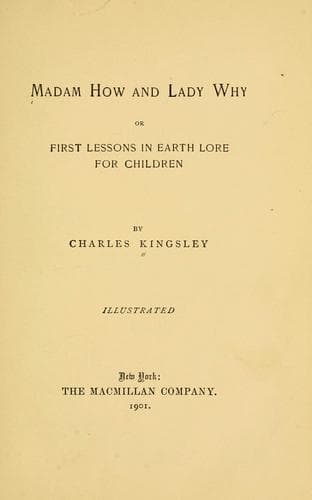
Madam How and Lady Why; Or, First Lessons in Earth Lore for ChildrenKingsley, Charles
History
Madam How and Lady Why; Or, First Lessons in Earth Lore for Children
Kingsley, Charles
Geology -- Juvenile literature; Natural history -- Juvenile literature
As certainly, boy, I believe, as that Waterloo is where the Duke fought
Napoleon. Yes: you may well stare at it with all your eyes, the noble
down. It is one of the most sacred spots on English soil.
Ah, it is gone now. The train runs so fast.
So it does; too fast to let you look long at one thing: but in return, it
lets you see so many more things in a given time than the slow old
coaches and posters did.--Well? what is it?
I wanted to ask you a question, but you won't listen to me.
Won't I? I suppose I was dreaming with my eyes open. You see, I have
been so often along this line--and through this country, too, long before
the line was made--that I cannot pass it without its seeming full of
memories--perhaps of ghosts.
Of real ghosts?
As real ghosts, I suspect, as any one on earth ever saw; faces and scenes
which have printed themselves so deeply on one's brain, that when one
passes the same place, long years after, they start up again, out of
fields and roadsides, as if they were alive once more, and need sound
sense to send them back again into their place as things which are past
for ever, for good and ill. But what did you want to know?
Why, I am so tired of looking out of the window. It is all the same:
fields and hedges, hedges and fields; and I want to talk.
Fields and hedges, hedges and fields? Peace and plenty, plenty and
peace. However, it may seem dull, now that the grass is cut; but you
would not have said so two months ago, when the fields were all golden-
green with buttercups, and the whitethorn hedges like crested waves of
snow. I should like to take a foreigner down the Vale of Berkshire in
the end of May, and ask him what he thought of old England. But what
shall we talk about?
I want to know about Coprolites, if they dig them here, as they do at
Cambridge.
I don't think they do. But I suspect they will some day.
But why do people dig them?
Because they are rational men, and want manure for their fields.
But what are Coprolites?
Well, they were called Coprolites at first because some folk fancied they
were the leavings of fossil animals, such as you may really find in the
lias at Lynn in Dorsetshire. But they are not that; and all we can say
is, that a long time ago, before the chalk began to be made, there was a
shallow sea in England, the shore of which was so covered with dead
animals, that the bone-earth (the phosphate of lime) out of them crusted
itself round every bone, and shell, and dead sea-beast on the shore, and
got covered up with fresh sand, and buried for ages as a mine of wealth.
But how many millions of dead creatures, there must have been! What
killed them?
Public-domain text, read in full here on John Shaqi.
Reviews
Reviews
No reviews yet
Be the first to share your thoughts on this work.
Elsewhere in the archive
Join the Discussion
Join the discussion
Sign in to leave a comment or review.
Sign InorCreate an account