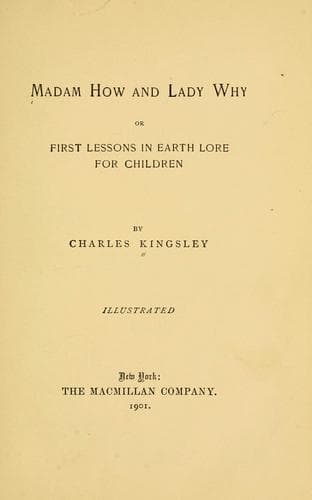
Madam How and Lady Why; Or, First Lessons in Earth Lore for ChildrenKingsley, Charles
History
Madam How and Lady Why; Or, First Lessons in Earth Lore for Children
Kingsley, Charles
Geology -- Juvenile literature; Natural history -- Juvenile literature
matter moves perpetually; and nothing "continues in one stay." The solid-
seeming earth on which you stand is but a heaving bubble, bursting ever
and anon in this place and in that. Only above all, and through all, and
with all, is One who does not move nor change, but is the same yesterday,
to-day, and for ever. And on Him, my child, and not on this bubble of an
earth, do you and I, and all mankind, depend.
But I have not yet told you why the Peruvians ought to have expected an
earthquake. True. I will tell you another time.
CHAPTER III--VOLCANOS
You want to know why the Spaniards in Peru and Ecuador should have
expected an earthquake.
Because they had had so many already. The shaking of the ground in their
country had gone on perpetually, till they had almost ceased to care
about it, always hoping that no very heavy shock would come; and being,
now and then, terribly mistaken.
For instance, in the province of Quito, in the year 1797, from thirty to
forty thousand people were killed at once by an earthquake. One would
have thought that warning enough: but the warning was not taken: and now,
this very year, thousands more have been killed in the very same country,
in the very same way.
They might have expected as much. For their towns are built, most of
them, close to volcanos--some of the highest and most terrible in the
world. And wherever there are volcanos there will be earthquakes. You
may have earthquakes without volcanos, now and then; but volcanos without
earthquakes, seldom or never.
How does that come to pass? Does a volcano make earthquakes? No; we may
rather say that earthquakes are trying to make volcanos. For volcanos
are the holes which the steam underground has burst open that it may
escape into the air above. They are the chimneys of the great
blast-furnaces underground, in which Madam How pounds and melts up the
old rocks, to make them into new ones, and spread them out over the land
above.
And are there many volcanos in the world? You have heard of Vesuvius, of
course, in Italy; and Etna, in Sicily; and Hecla, in Iceland. And you
have heard, too, of Kilauea, in the Sandwich Islands, and of Pele's
Hair--the yellow threads of lava, like fine spun glass, which are blown
from off its pools of fire, and which the Sandwich Islanders believed to
be the hair of a goddess who lived in the crater;--and you have read,
too, I hope, in Miss Yonge's _Book of Golden Deeds_, the noble story of
the Christian chieftainess who, in order to persuade her subjects to
become Christians also, went down into the crater and defied the goddess
of the volcano, and came back unhurt and triumphant.
But if you look at the map, you will see that there are many, many more.
Get Keith Johnston's Physical Atlas from the schoolroom--of course it is
there (for a schoolroom without a physical atlas is like a needle without
an eye)--and look at the map which is called "Phenomena of Volcanic
Action."
Public-domain text, read in full here on John Shaqi.
Reviews
Reviews
No reviews yet
Be the first to share your thoughts on this work.
Join the Discussion
Join the discussion
Sign in to leave a comment or review.
Sign InorCreate an account