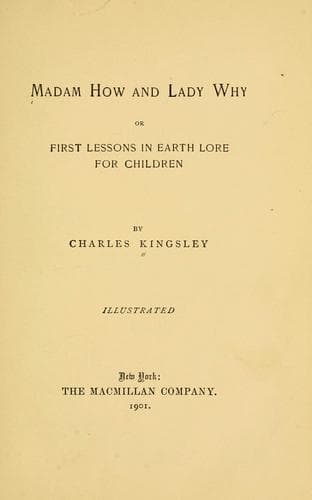
Madam How and Lady Why; Or, First Lessons in Earth Lore for ChildrenKingsley, Charles
History
Madam How and Lady Why; Or, First Lessons in Earth Lore for Children
Kingsley, Charles
Geology -- Juvenile literature; Natural history -- Juvenile literature
And now think what a wonderful fairy tale you might write for
yourself--and every word of it true--of the adventures of one atom of
Potash or some other Salt, no bigger than a needle's point, in such a
lava stream as I have been telling of. How it has run round and round,
and will run round age after age, in an endless chain of change. How it
began by being molten fire underground, how then it became part of a hard
cold rock, lifted up into a cliff, beaten upon by rain and storm, and
washed down into the soil of the plain, till, perhaps, the little atom of
mineral met with the rootlet of some great tree, and was taken up into
its sap in spring, through tiny veins, and hardened the next year into a
piece of solid wood. And then how that tree was cut down, and its logs,
it may be, burnt upon the hearth, till the little atom of mineral lay
among the wood-ashes, and was shovelled out and thrown upon the field and
washed into the soil again, and taken up by the roots of a clover plant,
and became an atom of vegetable matter once more. And then how, perhaps,
a rabbit came by, and ate the clover, and the grain of mineral became
part of the rabbit; and then how a hawk killed that rabbit, and ate it,
and so the grain became part of the hawk; and how the farmer shot the
hawk, and it fell perchance into a stream, and was carried down into the
sea; and when its body decayed, the little grain sank through the water,
and was mingled with the mud at the bottom of the sea. But do its
wanderings stop there? Not so, my child. Nothing upon this earth, as I
told you once before, continues in one stay. That grain of mineral might
stay at the bottom of the sea a thousand or ten thousand years, and yet
the time would come when Madam How would set to work on it again. Slowly,
perhaps, she would sink that mud so deep, and cover it up with so many
fresh beds of mud, or sand, or lime, that under the heavy weight, and
perhaps, too, under the heat of the inside of the earth, that Mud would
slowly change to hard Slate Rock; and ages after, it may be, Madam How
might melt that Slate Rock once more, and blast it out; and then through
the mouth of a volcano the little grain of mineral might rise into the
open air again to make fresh soil, as it had done thousands of years
before. For Madam How can manufacture many different things out of the
same materials. She may have so wrought with that grain of mineral, that
she may have formed it into part of a precious stone, and men may dig it
out of the rock, or pick it up in the river-bed, and polish it, and set
it, and wear it. Think of that--that in the jewels which your mother or
your sisters wear, or in your father's signet ring, there may be atoms
which were part of a live plant, or a live animal, millions of years ago,
and may be parts of a live plant or a live animal millions of years
hence.
Public-domain text, read in full here on John Shaqi.
Reviews
Reviews
No reviews yet
Be the first to share your thoughts on this work.
Elsewhere in the archive
Join the Discussion
Join the discussion
Sign in to leave a comment or review.
Sign InorCreate an account