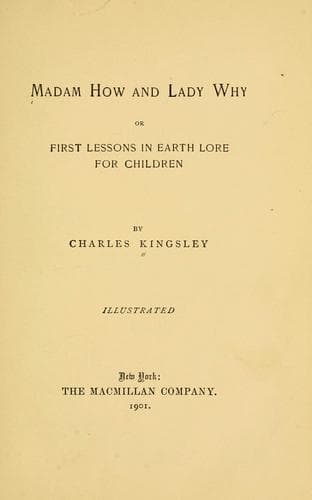
Madam How and Lady Why; Or, First Lessons in Earth Lore for ChildrenKingsley, Charles
History
Madam How and Lady Why; Or, First Lessons in Earth Lore for Children
Kingsley, Charles
Geology -- Juvenile literature; Natural history -- Juvenile literature
Think over again, and learn by heart, the links of this endless chain of
change: Fire turned into Stone--Stone into Soil--Soil into Plant--Plant
into Animal--Animal into Soil--Soil into Stone--Stone into Fire again--and
then Fire into Stone again, and the old thing run round once more.
So it is, and so it must be. For all things which are born in Time must
change in Time, and die in Time, till that Last Day of this our little
earth, in which,
"Like to the baseless fabric of a vision,
The cloud-capped towers, the gorgeous palaces,
The solemn temples, the great globe itself,
Yea, all things which inherit, shall dissolve,
And, like an unsubstantial pageant faded,
Leave not a rack behind."
So all things change and die, and so your body too must change and
die--but not yourself. Madam How made your body; and she must unmake it
again, as she unmakes all her works in Time and Space; but you, child,
your Soul, and Life, and Self, she did not make; and over you she has no
power. For you were not, like your body, created in Time and Space; and
you will endure though Time and Space should be no more: because you are
the child of the Living God, who gives to each thing its own body, and
can give you another body, even as seems good to Him.
CHAPTER V--THE ICE-PLOUGH
You want to know why I am so fond of that little bit of limestone, no
bigger than my hand, which lies upon the shelf; why I ponder over it so
often, and show it to all sensible people who come to see me?
I do so, not only for the sake of the person who gave it to me, but
because there is written on it a letter out of Madam How's alphabet,
which has taken wise men many a year to decipher. I could not decipher
that letter when first I saw the stone. More shame for me, for I had
seen it often before, and understood it well enough, in many another page
of Madam How's great book. Take the stone, and see if you can find out
anything strange about it.
Well, it is only a bit of marble as big as my hand, that looks as if it
had been, and really has been, broken off by a hammer. But when you look
again, you see there is a smooth scraped part on one edge, that seems to
have been rubbed against a stone.
Now look at that rubbed part, and tell me how it was done.
You have seen men often polish one stone on another, or scour floors with
a Bath brick, and you will guess at first that this was polished so: but
if it had been, then the rubbed place would have been flat: but if you
put your fingers over it, you will find that it is not flat. It is
rolled, fluted, channelled, so that the thing or things which rubbed it
must have been somewhat round. And it is covered, too, with very fine
and smooth scratches or grooves, all running over the whole in the same
line. Now what could have done that?
Public-domain text, read in full here on John Shaqi.
Reviews
Reviews
No reviews yet
Be the first to share your thoughts on this work.
Elsewhere in the archive
Join the Discussion
Join the discussion
Sign in to leave a comment or review.
Sign InorCreate an account