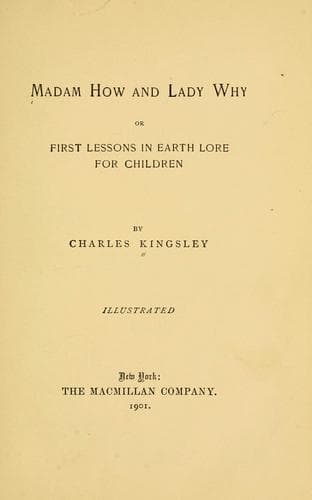
Madam How and Lady Why; Or, First Lessons in Earth Lore for ChildrenKingsley, Charles
History
Madam How and Lady Why; Or, First Lessons in Earth Lore for Children
Kingsley, Charles
Geology -- Juvenile literature; Natural history -- Juvenile literature
What is it? a piece of old mortar? Yes. But mortar which was made Madam
How herself, and not by any man. And what is in it? A piece of flint
and some bits of bone. But look at that piece of flint. It is narrow,
thin, sharp-edged: quite different in shape from any bit of flint which
you or I ever saw among the hundreds of thousands of broken bits of
gravel which we tread on here all day long; and here are some more bits
like it, which came from the same place--all very much the same shape,
like rough knives or razor blades; and here is a core of flint, the
remaining part of a large flint, from which, as you may see, blades like
those have been split off. Those flakes of flint, my child, were split
off by men; even your young eyes ought to be able to see that. And here
are other pieces of flint--pear-shaped, but flattened, sharp at one end
and left rounded at the other, which look like spear-heads, or
arrow-heads, or pointed axes, or pointed hatchets--even your young eyes
can see that these must have been made by man. And they are, I may tell
you, just like the tools of flint, or of obsidian, which is volcanic
glass, and which savages use still where they have not iron. There is a
great obsidian knife, you know, in a house in this very parish, which
came from Mexico; and your eye can tell you how like it is to these flint
ones. But these flint tools are very old. If you crack a fresh flint,
you will see that its surface is gray, and somewhat rough, so that it
sticks to your tongue. These tools are smooth and shiny: and the edges
of some of them are a little rubbed from being washed about in gravel;
while the iron in the gravel has stained them reddish, which it would
take hundreds and perhaps thousands of years to do. There are little
rough markings, too, upon some of them, which, if you look at through a
magnifying glass, are iron, crystallised into the shape of little sea-
weeds and trees--another sign that they are very very old. And what is
more, near the place where these flint flakes come from there are no
flints in the ground for hundreds of miles; so that men must have brought
them there ages and ages since. And to tell you plainly, these are
scrapers such as the Esquimaux in North America still use to scrape the
flesh off bones, and to clean the insides of skins.
But did these people (savages perhaps) live when the country was icy
cold? Look at the bits of bone. They have been split, you see,
lengthways; that, I suppose, was to suck the marrow out of them, as
savages do still. But to what animal do the bones belong? That is the
question, and one which I could not have answered you, if wiser men than
I am could not have told me.
Public-domain text, read in full here on John Shaqi.
Reviews
Reviews
No reviews yet
Be the first to share your thoughts on this work.
Elsewhere in the archive
Join the Discussion
Join the discussion
Sign in to leave a comment or review.
Sign InorCreate an account