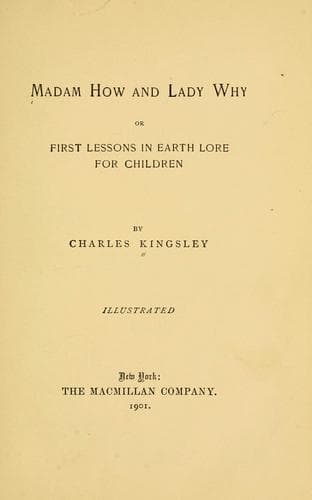
Madam How and Lady Why; Or, First Lessons in Earth Lore for ChildrenKingsley, Charles
History
Madam How and Lady Why; Or, First Lessons in Earth Lore for Children
Kingsley, Charles
Geology -- Juvenile literature; Natural history -- Juvenile literature
They are the bones of reindeer--such reindeer as are now found only in
Lapland and the half-frozen parts of North America, close to the Arctic
circle, where they have six months day and six months night. You have
read of Laplanders, and how they drive reindeer in their sledges, and
live upon reindeer milk; and you have read of Esquimaux, who hunt seals
and walrus, and live in houses of ice, lighted by lamps fed with the same
blubber on which they feed themselves. I need not tell you about them.
Now comes the question--Whence did these flints and bones come? They
came out of a cave in Dordogne, in the heart of sunny France,--far away
to the south, where it is hotter every summer than it was here even this
summer, from among woods of box and evergreen oak, and vineyards of rich
red wine. In that warm land once lived savages, who hunted amid ice and
snow the reindeer, and with the reindeer animals stranger still.
And now I will tell you a fairy tale: to make you understand it at all I
must put it in the shape of a tale. I call it a fairy tale, because it
is so strange; indeed I think I ought to call it the fairy tale of all
fairy tales, for by the time we get to the end of it I think it will
explain to you how our forefathers got to believe in fairies, and trolls,
and elves, and scratlings, and all strange little people who were said to
haunt the mountains and the caves.
Well, once upon a time, so long ago that no man can tell when, the land
was so much higher, that between England and Ireland, and, what is more,
between England and Norway, was firm dry land. The country then must
have looked--at least we know it looked so in Norfolk--very like what our
moors look like here. There were forests of Scotch fir, and of spruce
too, which is not wild in England now, though you may see plenty in every
plantation. There were oaks and alders, yews and sloes, just as there
are in our woods now. There was buck-bean in the bogs, as there is in
Larmer's and Heath pond; and white and yellow water-lilies, horn-wort,
and pond-weeds, just as there are now in our ponds. There were wild
horses, wild deer, and wild oxen, those last of an enormous size. There
were little yellow roe-deer, which will not surprise you, for there are
hundreds and thousands in Scotland to this day; and, as you know, they
will thrive well enough in our woods now. There were beavers too: but
that must not surprise you, for there were beavers in South Wales long
after the Norman Conquest, and there are beavers still in the mountain
glens of the south-east of France. There were honest little water-rats
too, who I dare say sat up on their hind legs like monkeys, nibbling the
water-lily pods, thousands of years ago, as they do in our ponds now.
Well, so far we have come to nothing strange: but now begins the fairy
tale. Mixed with all these animals, there wandered about great herds of
elephants and rhinoceroses; not smooth-skinned, mind, but covered with
Public-domain text, read in full here on John Shaqi.
Reviews
Reviews
No reviews yet
Be the first to share your thoughts on this work.
Elsewhere in the archive
Join the Discussion
Join the discussion
Sign in to leave a comment or review.
Sign InorCreate an account