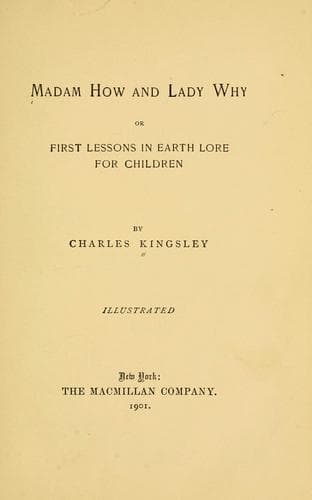
Madam How and Lady Why; Or, First Lessons in Earth Lore for ChildrenKingsley, Charles
History
Madam How and Lady Why; Or, First Lessons in Earth Lore for Children
Kingsley, Charles
Geology -- Juvenile literature; Natural history -- Juvenile literature
Now for my third chapter. "When things come to the worst," says the
proverb, "they commonly mend;" and so did this poor frozen and drowned
land of England and France and Germany, though it mended very slowly. The
land began to rise out of the sea once more, and rose till it was perhaps
as high as it had been at first, and hundreds of feet higher than it is
now: but still it was very cold, covered, in Scotland at least, with one
great sea of ice and glaciers descending down into the sea, as I said
when I spoke to you about the Ice-Plough. But as the land rose, and grew
warmer too, while it rose, the wild beasts who had been driven out by the
great drowning came gradually back again. As the bottom of the old icy
sea turned into dry land, and got covered with grasses, and weeds, and
shrubs once more, elephants, rhinoceroses, hippopotamuses, oxen--sometimes
the same species, sometimes slightly different ones--returned to France,
and then to England (for there was no British Channel then to stop them);
and with them came other strange animals, especially the great Irish elk,
as he is called, as large as the largest horse, with horns sometimes ten
feet across. A pair of those horns with the skull you have seen
yourself, and can judge what a noble animal he must have been. Enormous
bears came too, and hyaenas, and a tiger or lion (I cannot say which), as
large as the largest Bengal tiger now to be seen in India.
And in those days--we cannot, of course, exactly say when--there
came--first I suppose into the south and east of France, and then
gradually onward into England and Scotland and Ireland--creatures without
any hair to keep them warm, or scales to defend them, without horns or
tusks to fight with, or teeth to worry and bite; the weakest you would
have thought of the beasts, and yet stronger than all the animals,
because they were Men, with reasonable souls. Whence they came we cannot
tell, nor why; perhaps from mere hunting after food, and love of
wandering and being independent and alone. Perhaps they came into that
icy land for fear of stronger and cleverer people than themselves; for we
have no proof, my child, none at all, that they were the first men that
trod this earth. But be that as it may, they came; and so cunning were
these savage men, and so brave likewise, though they had no iron among
them, only flint and sharpened bones, yet they contrived to kill and eat
the mammoths, and the giant oxen, and the wild horses, and the reindeer,
and to hold their own against the hyaenas, and tigers, and bears, simply
because they had wits, and the dumb animals had none. And that is the
strangest part to me of all my fairy tale. For what a man's wits are,
and why he has them, and therefore is able to invent and to improve,
while even the cleverest ape has none, and therefore can invent and
improve nothing, and therefore cannot better himself, but must remain
from father to son, and father to son again, a stupid, pitiful,
Public-domain text, read in full here on John Shaqi.
Reviews
Reviews
No reviews yet
Be the first to share your thoughts on this work.
Elsewhere in the archive
Join the Discussion
Join the discussion
Sign in to leave a comment or review.
Sign InorCreate an account