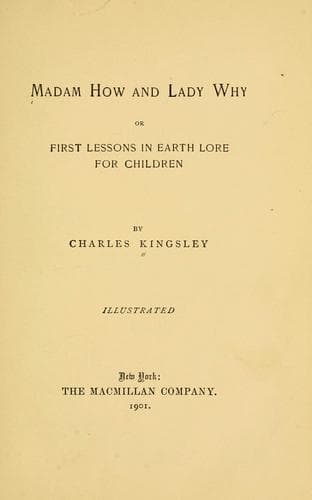
Madam How and Lady Why; Or, First Lessons in Earth Lore for ChildrenKingsley, Charles
History
Madam How and Lady Why; Or, First Lessons in Earth Lore for Children
Kingsley, Charles
Geology -- Juvenile literature; Natural history -- Juvenile literature
ridiculous ape, while men can go on civilising themselves, and growing
richer and more comfortable, wiser and happier, year by year--how that
comes to pass, I say, is to me a wonder and a prodigy and a miracle,
stranger than all the most fantastic marvels you ever read in fairy
tales.
You may find the flint weapons which these old savages used buried in
many a gravel-pit up and down France and the south of England; but you
will find none here, for the gravel here was made (I am told) at the
beginning of the ice-time, before the north of England sunk into the sea,
and therefore long, long before men came into this land. But most of
their remains are found in caves which water has eaten out of the
limestone rocks, like that famous cave of Kent's Hole at Torquay. In it,
and in many another cave, lie the bones of animals which the savages ate,
and cracked to get the marrow out of them, mixed up with their
flint-weapons and bone harpoons, and sometimes with burnt ashes and with
round stones, used perhaps to heat water, as savages do now, all baked
together into a hard paste or breccia by the lime. These are in the
water, and are often covered with a floor of stalagmite which has dripped
from the roof above and hardened into stone. Of these caves and their
beautiful wonders I must tell you another day. We must keep now to our
fairy tale. But in these caves, no doubt, the savages lived; for not
only have weapons been found in them, but actually drawings scratched (I
suppose with flint) on bone or mammoth ivory--drawings of elk, and bull,
and horse, and ibex--and one, which was found in France, of the great
mammoth himself, the woolly elephant, with a mane on his shoulders like a
lion's mane. So you see that one of the earliest fancies of this strange
creature, called man, was to draw, as you and your schoolfellows love to
draw, and copy what you see, you know not why. Remember that. You like
to draw; but why you like it neither you nor any man can tell. It is one
of the mysteries of human nature; and that poor savage clothed in skins,
dirty it may be, and more ignorant than you (happily) can conceive, when
he sat scratching on ivory in the cave the figures of the animals he
hunted, was proving thereby that he had the same wonderful and mysterious
human nature as you--that he was the kinsman of every painter and
sculptor who ever felt it a delight and duty to copy the beautiful works
of God.
Public-domain text, read in full here on John Shaqi.
Reviews
Reviews
No reviews yet
Be the first to share your thoughts on this work.
Elsewhere in the archive
Join the Discussion
Join the discussion
Sign in to leave a comment or review.
Sign InorCreate an account