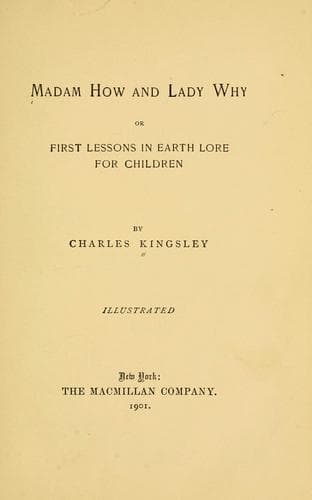
Madam How and Lady Why; Or, First Lessons in Earth Lore for ChildrenKingsley, Charles
History
Madam How and Lady Why; Or, First Lessons in Earth Lore for Children
Kingsley, Charles
Geology -- Juvenile literature; Natural history -- Juvenile literature
No, not that I ever heard of. There are, though, in limestone, which is
only a harder kind of chalk. Madam How could turn this chalk into hard
limestone, I believe, even now; and in more ways than one: but in ways
which would not be very comfortable or profitable for us Southern folk
who live on it. I am afraid that--what between squeezing and heating--she
would flatten us all out into phosphatic fossils, about an inch thick;
and turn Winchester city into a "breccia" which would puzzle geologists a
hundred thousand years hence. So we will hope that she will leave our
chalk downs for the Itchen to wash gently away, while we talk about
caves, and how Madam How scoops them out by water underground, just in
the same way, only more roughly, as she melts the chalk.
Suppose, then, that these hills, instead of being soft, spongy chalk,
were all hard limestone marble, like that of which the font in the church
is made. Then the rainwater, instead of sinking through the chalk as
now, would run over the ground down-hill, and if it came to a crack (a
fault, as it is called) it would run down between the rock; and as it ran
it would eat that hole wider and wider year by year, and make a swallow-
hole--such as you may see in plenty if you ever go up Whernside, or any
of the high hills in Yorkshire--unfathomable pits in the green turf, in
which you may hear the water tinkling and trickling far, far underground.
And now, before we go a step farther, you may understand, why the bones
of animals are so often found in limestone caves. Down such
swallow-holes how many beasts must fall: either in hurry and fright, when
hunted by lions and bears and such cruel beasts; or more often still in
time of snow, when the holes are covered with drift; or, again, if they
died on the open hill-sides, their bones might be washed in, in floods,
along with mud and stones, and buried with them in the cave below; and
beside that, lions and bears and hyaenas might live in the caves below,
as we know they did in some caves, and drag in bones through the caves'
mouths; or, again, savages might live in that cave, and bring in animals
to eat, like the wild beasts; and so those bones might be mixed up, as we
know they were, with things which the savages had left behind--like flint
tools or beads; and then the whole would be hardened, by the dripping of
the limestone water, into a paste of breccia just like this in my drawer.
But the bones of the savages themselves you would seldom or never find
mixed in it--unless some one had fallen in by accident from above. And
why? (For there is a Why? to that question: and not merely a How?)
Simply because they were men; and because God has put into the hearts of
all men, even of the lowest savages, some sort of reverence for those who
are gone; and has taught them to bury, or in some other way take care of,
their bones.
But how is the swallow-hole sure to end in a cave?
Because it cannot help making a cave for itself if it has time.
Public-domain text, read in full here on John Shaqi.
Reviews
Reviews
No reviews yet
Be the first to share your thoughts on this work.
Elsewhere in the archive
Join the Discussion
Join the discussion
Sign in to leave a comment or review.
Sign InorCreate an account