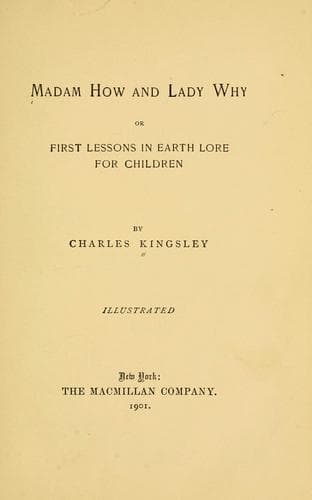
Madam How and Lady Why; Or, First Lessons in Earth Lore for ChildrenKingsley, Charles
History
Madam How and Lady Why; Or, First Lessons in Earth Lore for Children
Kingsley, Charles
Geology -- Juvenile literature; Natural history -- Juvenile literature
Think: and you will see that it must be so. For that water must run
somewhere; and so it eats its way out between the beds of the rock,
making underground galleries, and at last caves and lofty halls. For it
always eats, remember, at the bottom of its channel, leaving the roof
alone. So it eats, and eats, more in some places and less in others,
according as the stone is harder or softer, and according to the
different direction of the rock-beds (what we call their dip and strike);
till at last it makes one of those wonderful caverns about which you are
so fond of reading--such a cave as there actually is in the rocks of the
mountain of Whernside, fed by the swallow-holes around the mountain-top;
a cave hundreds of yards long, with halls, and lakes, and waterfalls, and
curtains and festoons of stalactite which have dripped from the roof, and
pillars of stalagmite which have been built up on the floor below. These
stalactites (those tell me who have seen them) are among the most
beautiful of all Madam How's work; sometimes like branches of roses or of
grapes; sometimes like statues; sometimes like delicate curtains, and I
know not what other beautiful shapes. I have never seen them, I am sorry
to say, and therefore I cannot describe them. But they are all made in
the same way; just in the same way as those little straight stalactites
which you may have seen hanging, like icicles, in vaulted cellars, or
under the arches of a bridge. The water melts more lime than it can
carry, and drops some of it again, making fresh limestone grain by grain
as it drips from the roof above; and fresh limestone again where it
splashes on the floor below: till if it dripped long enough, the
stalactite hanging from above would meet the stalagmite rising from
below, and join in one straight round white graceful shaft, which would
seem (but only seem) to support the roof of the cave. And out of that
cave--though not always out of the mouth of it--will run a stream of
water, which seems to you clear as crystal, though it is actually, like
the Itchen at Winchester, full of lime; so full of lime, that it makes
beds of fresh limestone, which are called travertine--which you may see
in Italy, and Greece, and Asia Minor: or perhaps it petrifies, as you
call it, the weeds in its bed, like that dropping-well at Knaresborough,
of which you have often seen a picture. And the cause is this: the water
is so full of lime, that it is forced to throw away some of it upon
everything it touches, and so incrusts with stone--though it does not
turn to stone--almost anything you put in it. You have seen, or ought to
have seen, petrified moss and birds' nests and such things from
Knaresborough Well: and now you know a little, though only a very little,
of how the pretty toys are made.
Public-domain text, read in full here on John Shaqi.
Reviews
Reviews
No reviews yet
Be the first to share your thoughts on this work.
Elsewhere in the archive
Join the Discussion
Join the discussion
Sign in to leave a comment or review.
Sign InorCreate an account